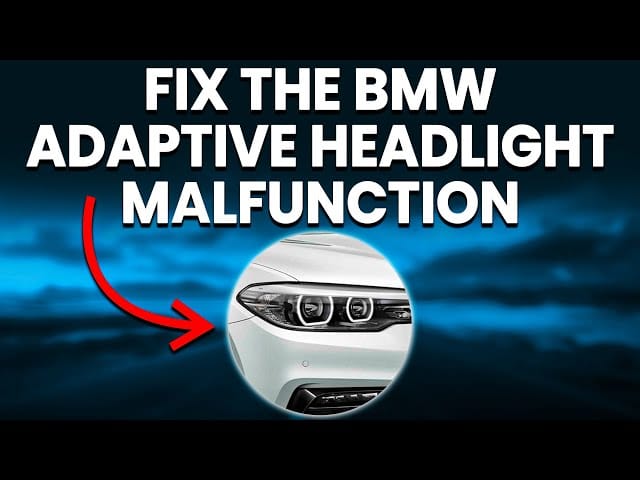
BMW Adaptive Headlight Malfunction: Codes, Causes & Real Costs
If your BMW just flashed “Adaptive Headlight Malfunction” on the dash, don’t panic! You’re in the right place. We’re gonna break it down in plain English with some laughs and real fixes along the way.
Adaptive headlight malfunction on BMW means your car’s fancy headlights, which turn with the road, aren’t working properly due to a sensor, wiring, moisture, or software issue.
Stick around, because we’ll show you what causes it, how to fix it (sometimes without a mechanic), and how to stop it from happening again. We’ll also decode the actual fault codes, tell you which BMW chassis are affected, and break down real repair costs so you know what you’re walking into.
Key Highlights
- Scan for Error Codes with OBD-II or BMW Diagnostic Tool
- Check for Loose or Damaged Headlight Wiring
- Inspect Adaptive Headlight Motors and Sensors
- Verify Functionality of the Headlight Control Module (FRM/LCM)
- Check the Leveling Sensor (usually on suspension arms)
- Ensure Battery Voltage is Stable (weak battery can trigger error)
- Clear the Error Code (if no physical issue is found)
- Replace Faulty Components if Needed (e.g., stepper motor, module)
- Recalibrate Adaptive Headlight System via Diagnostic Tool
- Test Drive the Vehicle to Confirm the Repair
What Are Adaptive Headlights in a BMW?

Okay, imagine your headlights could think. That’s pretty much what adaptive headlights do. On a BMW, they don’t just shine forward; they turn left or right when you steer. Fancy, right?
These smart lights help you see around corners at night. They follow your steering wheel, adjusting the light beam to match your direction. So, if you’re turning left, your lights also swing left to show the road. No more driving blind into the curve!
BMW refers to this as an “adaptive headlight” or sometimes “dynamic lighting.” It’s part of a system that uses sensors, motors, and sometimes cameras. The system checks your speed, steering angle, and even if you’re going uphill or downhill.
This setup is super useful in cars like the BMW 3 Series, 5 Series, X3, and X5. It makes night driving safer, especially on twisty roads or in bad weather.
But here’s the thing: with all that fancy tech, things can break. And when they do? Bam, your dashboard says “Adaptive Headlight Malfunction.” Not fun. But don’t worry, we’ll get into that mess next!
Read More: Adaptive M Suspension on BMW
Main Causes of Adaptive Headlight Malfunction in BMWs
If your BMW throws a tantrum with that “adaptive headlight malfunction” warning, don’t worry, it’s not haunted. But something in the system is acting up. Let’s check the usual troublemakers one by one.

Faulty Adaptive Headlight Control Module
This little box is the boss of your headlights. It tells them when and how to turn. If the module goes bad, your lights might freeze in place or stop working altogether. You might even hear clicking sounds or see lights flicker like they’re confused. On many BMWs this is called the AHL module (Adaptive Headlight), and on some chassis the footwell module (FRM) or light control module (LCM) handles part of the job.
Why it fails: Water damage, electrical surges, or just old age. Fix: Scan it with a BMW-specific tool. If it’s dead, you’ll need a new module, usually $600–$1,200 for the part alone, plus coding.
Broken or Dirty Headlight Leveling Sensor
This sensor (also called the ride height sensor) sits on your suspension and tells the headlights how high or low to point. Hit a pothole? Drive through mud? The sensor gets knocked loose or gunked up. BMWs typically have one at the front and one at the rear.
What you’ll notice: Lights pointing too high, too low, or no movement at all.
Fix: Clean it first. If that doesn’t help, a new sensor usually costs $100–$300.
Wiring Harness Issues or Loose Connections
BMWs have a jungle of wires behind those headlights. One loose connector or frayed wire, and your adaptive system goes full drama queen. The wiring harness runs from the AHL module to each headlight and to the leveling sensors, so a break anywhere along that path can trigger the warning.
Clues: Error pops up after hitting a bump. Sometimes works, sometimes doesn’t.
Fix: Wiggle-test the wires while someone watches the dashboard. Replace or secure any sketchy connections.
Moisture Inside the Headlight Housing
Water in your headlights = bad news. It can mess with sensors, bulbs, and the adaptive system. BMWs aren’t fans of rainy days if the seals go bad.
Signs: Foggy lens, flickering lights, or the error only shows up after washing the car.
Fix: Dry it out with a hairdryer (yes, really), then reseal it or replace the gasket.
Damage from Minor Accidents or Bodywork
Even a light bump to the bumper can mess up the alignment or break the tiny parts that help the headlights move.
How you’ll know: You recently had a fender bender or bumper job, and now the warning’s here.
Fix: Check for broken mounting points or misaligned headlight brackets. A body shop may need to realign it.
Software Glitches After Battery Change or Updates
BMW is a computer on wheels. A battery swap or a wonky update can confuse the adaptive light system, and so can a weak or dying battery that drops voltage during startup.
What happens: The lights stop turning, or the error shows up after a battery replacement.
Fix: Use a BMW-specific scan tool to reset or reprogram the system. In some cases, the dealer has to step in.
Which BMW Models and Years Are Affected
Adaptive headlights have been offered across most of the BMW lineup since the mid-2000s, but the failure patterns differ by chassis and by lighting technology. Knowing which system your car has changes how you diagnose it.
Xenon vs LED vs Laser Adaptive Systems
Xenon adaptive headlights (common on E90, E60, F10, F30, and early X3/X5) use a swivel motor inside the housing to physically turn the projector. These are the most failure-prone because they have moving parts, ballasts, and igniters. LED adaptive systems (G20, G30, G01) use multiple LED segments and a stepper motor, with fewer wear items but more electronics. Laser (BMW Laserlight) systems on the 7 Series and i8 are the most complex and the most expensive to repair, and are usually dealer-only for diagnostics.
The fault code format also changes by chassis. Older E-series cars report codes like A8B1, while F- and G-series cars use hex codes such as 800FC4 and 9CBB. Always match the code to your specific chassis before ordering parts.
Fault Codes That Pinpoint the Failed Part
You don’t need to be a BMW wizard to figure this out. Just follow these simple steps, and you’ll feel like the headlight whisperer in no time. Let’s catch that “adaptive headlight malfunction” before it causes more drama.
Using a BMW OBD2 Scanner or iCarly App

First, grab a BMW-friendly scanner. ISTA/Rheingold is the dealer-level software, while Foxwell, Autel, and BimmerLink are common DIY options. Plug it into your car’s OBD2 port (under the dash near your knees) and run a scan. The exact code tells you which part to suspect before you buy anything.
Pro tip: Clear the code and see if it comes back. If it does, bingo you’ve got a confirmed problem.
Checking Headlight Movement During Startup
When you turn on your BMW, the adaptive headlights should do a little “dance.” They move left, right, up, and down to test themselves. If your lights just sit there like grumpy cats, something’s wrong.
No movement = possible sensor or module issue. Weird movement = maybe misaligned or stuck. One side only = usually that headlight’s swivel/stepper motor or its wiring.
Visually Inspecting Sensors on Suspension Arms
Time to crouch down like a spy and peek behind your front and rear wheels. You’ll see small plastic arms with wires; those are the headlight leveling sensors (ride height sensors).
Check if they’re:
- Broken
- Covered in dirt
- Hanging loose like they gave up on life
A snapped sensor arm = no headlight signals = malfunction alert. If the arm is intact but the sensor reads a stuck value, the module will also throw a fault.
Spotting Water or Fog in the Headlight Lens
Foggy headlights aren’t just ugly; they mess with electronics. Look closely at your headlight lens. If you see water droplets or cloudy fog, you might have a leaky seal.
Moisture can short out the adaptive system.
Also, look for rust near the connectors; that’s a red flag.
Signs of Wiring Wear or Connector Damage
Wiggle the headlight wires gently (like, really gently). Do the lights flicker or the warning appear? Boom, bad wiring. Look for:
- Cracked insulation
- Loose plugs
- Frayed wires
BMWs have sensitive wiring. One loose connector can make the whole system act weird.
How to Verify Module vs Sensor vs Motor Before Buying Parts
This is the step most DIYers skip, and it’s the one that saves the most money. Before you buy anything, confirm which part is actually bad.
- Sensor test: With ISTA or a capable scanner, watch live data from the ride height sensors while you push down on the suspension. If the value doesn’t change, the sensor is dead or the arm is broken.
- Motor test: Command the swivel/stepper motor through the scanner’s activation menu. If the other side moves but this one doesn’t, the motor or its wiring is the problem, not the module.
- Wiring test: Check for continuity and voltage at the headlight connector with the key on. No voltage where there should be means a harness break, not a bad module.
- Module test: Only after the sensor, motor, and wiring all check out should you suspect the AHL or FRM module. A module fault usually shows up as multiple unrelated codes at once.
Easy DIY Fixes You Can Try at Home
Got an “adaptive headlight malfunction” warning on your BMW? Don’t panic. You don’t need to sell your car or beg a dealership just yet. Here are some easy fixes you can try in your garage or driveway, if you’re fancy.
Clear Moisture and Reseal the Headlight

If you see fog or water inside the headlight, that’s a big clue. Moisture messes with the sensors and wiring inside.
Here’s what you’re realistically looking at, part plus labor, depending on where you go:
- Leveling/ride height sensor: $100–$300 part, 1 hour labor. DIY-friendly.
- Swivel/stepper motor inside headlight: $150–$400 part, 1–2 hours. Sometimes the whole headlight is cheaper used.
- AHL control module: $600–$1,200 part, 1–2 hours, plus coding. Dealer-only on some chassis.
- Wiring harness repair: $50–$200 in parts, 1–3 hours depending on where the break is.
- Headlight assembly (if moisture killed it): $800–$2,000+ per side new, less for used or aftermarket.
Labor rates run roughly $80–$150/hour at an independent BMW shop and $150–$250/hour at a dealer. Indy shops with ISTA can usually handle everything except factory coding on the newest chassis.
Clean or Replace the Headlight Level Sensor
That little sensor near your wheel helps the lights know where to aim. Dirt or rust on it can confuse the whole system.
Try this first:
- Spray it down with brake cleaner or electronics cleaner.
- Wiggle it if it’s super loose or broken; time for a new one.
New sensors cost around $100–$300. Not cheap, but way better than replacing the whole headlight.
Reset the Adaptive Headlight System With a Scan Tool
Sometimes your BMW just needs a good ol’ reset like your phone after too many weird popups.
What to do:
- Plug in a BMW OBD2 scanner (ISTA, BimmerLink, Foxwell, or Carly).
- Find the adaptive headlight or AHL section in the app or menu.
- Clear the fault codes and run the initialization/calibration routine if your tool supports it.
- Cycle the ignition and watch the startup sweep to confirm the lights move.
If the light goes away and stays gone after a proper calibration, boom, you win. If it comes back immediately, the fault is physical, not software.
Disconnect Battery to Trigger a System Reboot
This trick works sometimes. It forces your BMW to reset its brain.
How to do it safely:
- Turn everything off.
- Disconnect the negative battery cable (black one).
- Wait 10–15 minutes.
- Reconnect and restart the car.
Warning: This may reset other systems like your radio presets or clock. It’s harmless, just mildly annoying.
Reset and Recalibration With ISTA (Step-by-Step)
Clearing the code is not the same as recalibrating the system. If you’ve replaced a sensor, motor, or module, you must run the initialization routine or the fault will come right back.
- Connect your laptop with ISTA/Rheingold (or a capable tool like BimmerLink) to the OBD2 port.
- Read and save the fault memory so you have a record of what triggered the warning.
- Clear the fault codes in the AHL/FRM/LCM module.
- Enter the service function for headlight adjustment or AHL initialization.
- Follow the prompts to let the system sweep the lights to their mechanical limits and relearn center position.
- Confirm the headlight aim is correct on a wall or with a beam setter, and adjust mechanically if needed.
- Cycle the ignition and re-scan to confirm no codes return.
When You Should Take It to a BMW Mechanic
Sometimes, no matter how many wires you wiggle or sensors you clean, that “adaptive headlight malfunction” just won’t quit. That’s when it’s time to wave the white flag and call in the BMW pros.
If Module or Sensor Replacement Is Needed

Replacing the adaptive headlight control module isn’t like swapping a light bulb. It’s buried deep, needs coding to the car, and costs a chunk of cash, usually $600 to $1,500 including labor.
The same goes for headlight level sensors if they’re totally broken or rusted out. You don’t want to guess with these parts. A mechanic can test, confirm, and install the right fix without turning your car into a science project.
Software Reprogramming or Recoding Required
BMW is like a moody laptop on wheels. Sometimes the adaptive headlight system just needs a software update or a fresh code input. This is where ISTA/Rheingold comes in, and it’s also how you recalibrate the system after replacing a sensor or module.
You’ll know this is the case if:
- The lights stopped working after a battery swap
- You installed aftermarket parts
- The scanner says, “Coding required.”
Only a BMW shop (or someone with ISTA/Rheingold and the right cable) can handle coding and calibration on most chassis. A generic OBD2 scanner can read and clear codes but usually can’t code a new module.
You’ve Tried DIY and the Error Keeps Coming Back
You dried the headlights.
You cleaned the sensors.
You even sweet-talked the car.
But the “adaptive headlight malfunction” warning still shows up every time you start the engine? That’s your cue to hand it over to a pro.
They’ll run full diagnostics, check voltage, and maybe even test parts you didn’t know existed. Plus, they’ve seen it all; your car isn’t their first drama queen.
Adaptive Headlight Delete: When It Makes Sense
Some owners of high-mileage or heavily modified BMWs choose to code out the adaptive function entirely rather than chase an intermittent fault. This is done by disabling the AHL feature in the FRM or LCM module so the lights still work as standard fixed headlights and the warning stops appearing.
It makes sense if the car is out of warranty, the repair cost is more than the car is worth to you, or you’ve swapped in aftermarket headlights that don’t support the adaptive function. It does not make sense on a car you plan to sell to a buyer who expects everything working, and it may affect inspection in some regions. The lights will still function as normal low and high beams, but they won’t turn with the steering.
How Much Does It Cost to Fix Adaptive Headlight Malfunction?
Wondering if fixing that “adaptive headlight malfunction” will break the bank? Well, it can sting a little, but knowing what to expect helps you dodge surprise bills.

Module Replacement Costs
If the adaptive headlight control module is toast, get ready to spend between $600 and $1,500 including labor. This module controls how your headlights move, so it’s a big deal, and on some chassis it needs dealer-level coding after install.
Sensor Replacement Costs
A broken or dirty headlight leveling sensor usually costs $100 to $300 for the part, plus about an hour of labor. It’s smaller and cheaper than the module, but still important. Sensors tell your lights where to point, so don’t skip this fix.
Labor Costs: DIY vs Pro Mechanic
Doing it yourself? You might spend zero bucks if you already have the tools (and patience). But if you call a mechanic, labor can cost $80 to $150 per hour at an independent shop, or $150 to $250 per hour at a dealer. Most repairs take 1–3 hours.
Warranty and Coverage
Good news! If your BMW is still under factory warranty or Certified Pre-Owned (CPO) coverage, some or all of these repairs might be free. Check your paperwork or call the dealer to find out.
BMW Models Most Affected by This Issue
Not all BMWs are created equal when it comes to adaptive headlight malfunctions. Some models seem to get this warning light more often, like they’re picking favorites.
BMW 3 Series (Especially F30)
The 3 Series is a fan favorite, but the F30 generation (2012–2019) loves throwing adaptive headlight errors. The mix of sensors and software in these models can get confused, especially after battery changes or bumps in the road. E90 and G20 models also show up, but less often.
BMW 5 Series
The 5 Series is a bit fancier, but that doesn’t mean it’s immune. The F10 and G30 generations often have more complex adaptive lighting, which means more parts that can fail, like sensors and control modules. Keep an eye on those warning lights.

BMW X3 and X5 SUVs
If you drive an X3 or X5, your BMW has adaptive headlights, too. These SUVs face extra wear and tear from rough roads and bumps, which can loosen sensors or damage wiring, triggering the dreaded malfunction. F25 and G01 X3s and F15 and G05 X5s are common offenders.
Other BMWs With Adaptive Lighting
Many newer BMW models, including the 4 Series, 7 Series, and some M models, have adaptive headlights. While less common, they can still get this error, especially if the system hasn’t been maintained or has been messed with by aftermarket parts. LED and Laser systems are generally more reliable than the older Xenon setups but cost more when they do fail.
Final Words
So there you have it, adaptive headlight malfunctions on BMWs aren’t magic, just a mix of sensors, wires, and fancy modules throwing a hissy fit. Most problems come from dirty sensors, loose wires, or a moody control module. Sometimes you can fix it yourself with a little cleaning, drying, or a proper reset and recalibration. Other times, you’ll need a mechanic’s magic touch.
Remember: a blinking warning light isn’t a reason to freak out, but it is your car asking for help. Catch it early, fix what you can, and don’t let those fancy headlights turn into a fancy headache.
And if your BMW’s adaptive headlights ever start dancing on their own, maybe it’s just trying to show off. Just don’t join in unless you want to be the car that out-dazzles the disco ball!
Related posts:
 Which BMW Has 3 Rows? X7, iX, and X5 Explained
 BMW Stalls When Stopping: Causes, Codes, Costs & Fixes
 Where To Buy BMW Coolant: Best Sources, Prices & Fitment
 What BMW Has the B58 Engine? Full Model List, Years, and Outputs
 BMW Restraint System Malfunction: Causes, Codes & Fixes
 My BMW App Not Working? Symptom Checker & Quick Fixes
 How To Decode BMW VIN: Step-by-Step Guide With Examples
 How To Check BMW Transmission Fluid Level (Dipstick & Sealed)
 How To Connect To BMW WiFi: Step-By-Step Guide (2025)
 Bmw Leaking Coolant But Not Overheating: Causes & Fixes
 BMW Limp Mode: Causes, OBD-II Codes & Fixes Explained
 F150 Jump Seat Console Organizer: Fitment Chart & Top Picks