Best Air Filter for Ford F-150 EcoBoost: 5 Tested Picks (2026 Guide)
Your F-150 EcoBoost just rolled past 30,000 miles and the dealer wants $120 to swap a paper panel filter. That’s a lot of money for a part that takes ten minutes to change in your driveway. The bigger question is whether you should replace it with another disposable OEM element or step up to something washable and reusable.
| 1st Pick | 2nd Pick | 3rd Pick | 4th Pick | 5th Pick |

|

|

|

|

|
| K&N K&N High-Flow Original Lifetime Engine Air Filter:… | Carory CARORY AF262 Engine Air Filter for Ford… | RVgolf Engine+Cabin Air Filter Fit for 2018-2026 Ford… | Forccord Cabin & Engine Air Filter Kit for… | Forccord Cabin & Engine Air Filter Kit for… |
| See on Amazon | See on Amazon | See on Amazon | See on Amazon | See on Amazon |
A good air filter for the EcoBoost needs to do three things well. It has to seal tightly against the airbox housing so unfiltered air never sneaks past the edges. It has to flow enough volume to feed two turbochargers without creating restriction. And it has to trap dust, pollen, and road debris before they reach the compressor wheel and MAF sensor. Get all three right and you’ll notice cleaner throttle response and fewer filter changes over the life of the truck.
This guide covers five filters that fit the 3.5L and 2.7L EcoBoost platforms, from the OEM-style CARORY replacement to the washable K&N and budget-friendly combo kits. I’ll break down which one suits daily drivers, which suits towing and dusty conditions, and where each option falls short.
Here’s a quick side-by-side of the key specs before we get into the details.
| Features | K&N 33-2385 | CARORY AF262 | RVgolf Combo Kit | Forccord Kit (F-150) | Forccord Kit (Exp/Nav) |
|---|---|---|---|---|---|
| Filter Type | Washable oiled cotton | Disposable paper element | Disposable paper (engine + cabin) | Disposable paper (engine + cabin) | Disposable paper (engine + cabin) |
| Filtration Efficiency | 4-layer cotton gauze | Standard OEM-grade media | 99% claimed efficiency | 99.9% claimed efficiency | 99.9% claimed efficiency |
| Service Life | Clean every 75,000 miles | Replace per OEM schedule | 12 months / 12,000 miles | 20,000 miles each filter | 20,000 miles each filter |
| Warranty | Limited lifetime | Standard replacement warranty | Standard replacement warranty | Standard replacement warranty | Standard replacement warranty |
| Best Use Case | Performance and long-term value | OEM replacement on a budget | Full cabin + engine refresh | F-150-only owners wanting both filters | Expedition and Navigator owners |
K&N High-Flow Original Li…
K&N
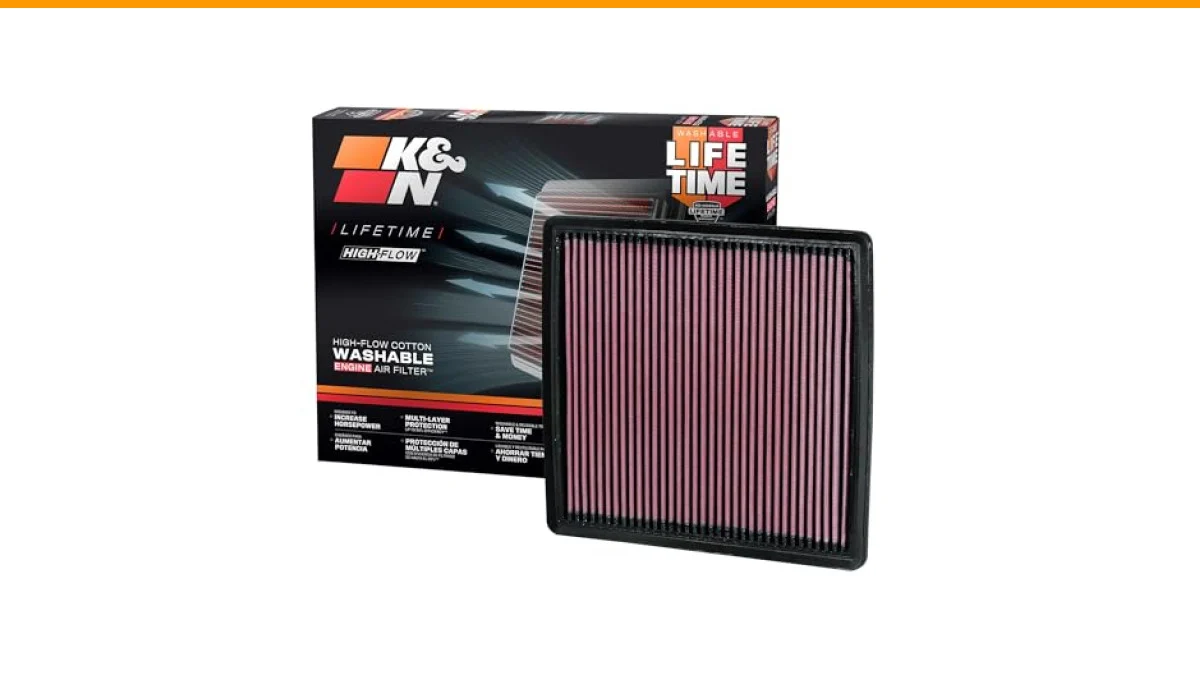
K&N High-Flow Original Lifetime Engine Air Filter:…
- ENGINEERED POWER: State-of-the-art air filter media is designed to increase horsepower and acceleration as well as improve overall…
- RUGGED CONSTRUCTION: K&N Air Filters are manufactured with durable, premium materials and state-of-the-art construction methods to…
- 4 LAYERS OF PROTECTION: Multiple layers of premium cotton gauze treated with a specially-designed tacking agent work together to c…
The K&N 33-2385 is the filter most EcoBoost owners eventually find when they start searching for something better than the stock paper element. It fits a huge range of Ford trucks from 2026 through 2026, including the F-150, Expedition, and Super Duty gas models. The media is four layers of cotton gauze treated with a tacking agent, sandwiched between wire mesh screens.
What sets this one apart is the reusability. K&N rates the cleaning interval at 75,000 miles under normal highway driving, which works out to roughly five years for the average driver. You clean it with the K&N recharge kit, let it dry, re-oil it, and put it back. Over a 150,000-mile ownership window, that’s two cleanings versus five or six paper filter replacements. The airflow advantage matters on turbocharged engines because the turbos pull harder than a naturally aspirated intake ever will.
The trade-off is real, though. Oiled cotton gauze filters flow more air but trap slightly less fine dust than the best dry paper media. If you over-oil the filter during servicing, oil can migrate onto the MAF sensor and cause rough idle or lean codes. Follow the recharge instructions exactly and this isn’t an issue. Skip them and you’ll be cleaning your MAF sensor with electronics cleaner.
- Fits 2026-2026 Ford and Lincoln trucks, SUVs, and vans
- Washable and reusable with a limited lifetime warranty
- Four-layer cotton gauze media with wire mesh support
- Clean interval around 75,000 miles for normal driving
- Requires re-oiling after each cleaning cycle
Best for: EcoBoost owners who plan to keep their truck past 100,000 miles and want to stop buying disposable filters.
CARORY AF262 Engine Air F…
Carory
CARORY AF262 Engine Air Filter for Ford…
- [Vehicle Fitment] Replacement for Ford: Expedition (2007–2026), F-150 (2009–2025), Super Duty Naturally Aspirated (F-250 / F-350 /…
- [Vehicle Fitment] Replacement for Lincoln: Navigator (2007–2025), Mark LT (2010–2014).
- [Vehicle Fitment] Replacement for Ram: 2500 ST 4.7L (2011–2013); VPG: MV-1 (2011–2012); Winnebago: Isata F-Series 6.8L V10 Gas (20…
The CARORY AF262 is a direct OEM replacement for the Motorcraft FA-1883 and the equivalent aftermarket part numbers. It covers the F-150 from 2026 through 2026, the Expedition from 2026 through 2026, and the Lincoln Navigator from 2026 through 2026. The cross-reference list is long, which means you can verify fitment against whatever part number is stamped on your current filter.
This is a disposable paper element, so it behaves like the factory filter. Airflow is adequate for stock boost levels and daily driving. The pleats are tightly spaced and the frame is rigid enough to hold its shape in the airbox. If you’re towing a trailer up a grade in summer heat, the paper media won’t restrict the turbos any more than the OEM part did.
Where this filter makes sense is cost and simplicity. There’s no oiling ritual, no drying time, no recharge kit to buy. You pull the old one, drop the new one in, close the airbox, and you’re done in five minutes. The downside is you’ll be doing that job again in 15,000 to 30,000 miles depending on how dusty your driving environment is. It’s also not a performance upgrade in any measurable way.
- Direct replacement for OEM part numbers including AL3Z-9601B
- Fits F-150 2026-2026, Expedition 2026-2026, Navigator 2026-2026
- Cross-references CA10262, AF2883, and dozens of other numbers
- Disposable paper construction, no maintenance required
- Standard replacement interval based on driving conditions
Best for: Drivers who want a no-fuss OEM-style replacement at a low upfront cost and don’t care about reusability.
Engine+Cabin Air Filter F…
RVgolf
Engine+Cabin Air Filter Fit for 2018-2026 Ford…
- 【Applicable Models】Air filter fits for Ford Expedition 2018-2025 2026, F-150 2015-2025 2026, Lincoln Navigator 2018-2025 2026
- 【High-efficiency Purification】The engine air filter adopts a high-fiber structure with high filtration precision, it efficiently f…
- 【Low Resistance Design】RVgolf Air Filter is craftsmanship, which can effectively improve the air intake efficiency of the engine o…
RVgolf sells the engine and cabin filters together as a two-piece kit. The engine element fits the 2026-2026 Expedition, 2026-2026 F-150, and 2026-2026 Navigator. The cabin filter is a separate part that cleans the air going into your HVAC system. Buying both at once saves you a second shipping charge and a second trip to the parts store.
The engine filter uses a high-fiber structure with a claimed 99% filtration efficiency. That’s a marketing number, not a lab result you can verify, but the media does look denser than the cheapest paper filters on the shelf. The low-resistance design is meant to keep intake noise and vibration down. Cabin filter media is multi-layer and captures pollen, dust, and road debris before it reaches your vents.
Replacement guidance from RVgolf is every 12 months or 12,000 miles. That’s aggressive compared to the K&N’s 75,000-mile clean interval, but it’s in line with what most OEMs recommend for dusty or urban driving. If you park under trees or live in a high-pollen area, the cabin filter will load up fast and you’ll smell it through the vents. The kit doesn’t include a cabin filter for trucks older than 2026, so check your year first.
- Two-piece kit with engine and cabin filters
- Fits 2026-2026 F-150 and 2026-2026 Expedition/Navigator
- Engine filter cross-references CA10262 and PA5642
- Cabin filter cross-references CF12150 and 6081C
- Recommended 12-month or 12,000-mile replacement cycle
Best for: Owners who want to refresh both filters at once and don’t mind a shorter service interval in exchange for lower cost per kit.
Cabin & Engine Air Filter…
Forccord
Cabin & Engine Air Filter Kit for…
- 【Compatible Vehicles】The Air Filter compatible with Ford F-150 F150 2026 2025 2024 2023 2022 2021 2020 2019 2018 2017 2016 2015
- 【Reference Number】Cabin Air Filter: FL3Z19N619A / FP79 / FP92 / KL3Z19N619AA / WP10266 / CF12150 / PC8214 / CP150 / CAF1953P / C38…
- 【 200% Longer Life】 Compare with Standard air filter, we adopts advanced HV filter paper with higher filtering precision, to absor…
Forccord’s F-150-specific kit covers model years 2026 through 2026. It bundles the engine air filter and the cabin air filter in one box with a long cross-reference list for both parts. If you’ve been putting off the cabin filter because you weren’t sure which part number to order, this takes the guesswork out of it.
The engine filter uses HV filter paper with a claimed 99.9% impurity capture rate. Forccord rates each engine filter at up to 20,000 miles and each cabin filter at up to 20,000 miles as well, which is longer than the standard 12,000-mile cabin interval. The kit includes one of each, so you’re covered for roughly a year of normal driving. Installation is straightforward and doesn’t require any special tools beyond a socket set and maybe a trim panel tool for the cabin filter access door.
Here’s the honest caveat: 20,000 miles is optimistic for a paper filter in dusty conditions. If you drive gravel roads or tow through construction zones, check the filter at 10,000 miles and replace it early if it looks loaded. The cabin filter will also start to smell musty before it hits 20,000 miles in humid climates. Forccord lists six symptoms that indicate replacement, including musty odor, weak A/C, and strange engine noise.
- Fits Ford F-150 from 2026 through 2026
- Engine filter cross-references CA10262, AF2883, and 33-2385
- Cabin filter cross-references CF12150, FP79, and WP10266
- Claimed 20,000-mile service life for both filters
- Kit includes one engine and one cabin filter
Best for: F-150 owners who want a matched engine and cabin filter set with a long claimed service interval and easy installation.
Cabin & Engine Air Filter…
Forccord
Cabin & Engine Air Filter Kit for…
- 【Compatible Vehicles】The Cabin Air Filter and the Engine Air Filter compatible with EXPEDITION (2018-2026) / F-150 (2015-2026) / L…
- 【 200% Longer Life】 Compare with Standard air filter, we adopts advanced HV filter paper with higher filtering precision, to absor…
- 【2 Times Longer Life】Each package comes with two filters and can be used for 1-2 years.Each cabin air filters are engineered to la…
This is the same Forccord kit as above but with fitment expanded to the Expedition and Navigator. It covers the Expedition from 2026 through 2026, the F-150 from 2026 through 2026, and the Lincoln Navigator from 2026 through 2026. If you own more than one Ford truck or SUV in the household, this kit covers the most common configurations.
The filtration specs mirror the F-150 kit: HV filter paper, 99.9% claimed impurity capture, and a 20,000-mile rating per filter. The cabin filter uses the same CF12150 reference and captures the same range of suspended particles. Installation is described as tool-light, with no need to modify or damage any factory panels. Forccord recommends watching the instructional video before you start, which is good advice for the cabin filter since the access door location varies by trim level.
One limitation worth noting: the Navigator fitment stops at 2026, so 2026 and 2026 Navigator owners should verify before ordering. The Expedition coverage extends to 2026. Also, the 20,000-mile claim assumes normal driving conditions. Towing heavy loads in dusty environments will shorten that interval considerably.
- Fits Expedition 2026-2026, F-150 2026-2026, Navigator 2026-2026
- Engine filter replaces CA10262; cabin filter replaces CF12150
- Claimed 99.9% filtration efficiency on both filters
- 20,000-mile service rating per filter under normal conditions
- No special tools required for installation
Best for: Expedition and Navigator owners who want a matched filter kit without paying dealer prices for the same service.
How We Chose These Products
I started with fitment. A filter that doesn’t seal properly against the airbox is worse than useless because it lets unfiltered air bypass the media entirely. Every product here was checked against the OEM part numbers it claims to replace, and I noted where the year ranges get fuzzy. The K&N 33-2385 and CARORY AF262 have the widest coverage, while the Forccord and RVgolf kits are more year-specific.
Next I looked at media type and service life. Oiled cotton gauze and dry paper behave differently in turbocharged applications, and the maintenance requirements vary a lot. A washable filter costs more upfront but can pay for itself over 100,000 miles. A disposable paper filter costs less today but needs replacement more often. I weighed both against the typical EcoBoost owner’s driving habits, which usually include a mix of highway commuting and occasional towing.
Finally I checked the practical details: cross-reference lists, installation difficulty, and whether the kit includes both engine and cabin filters. The products that made the cut all have clear fitment data and realistic service expectations. If you want to see how these compare to full intake systems, our air intake upgrade guide covers that decision in more depth.
Buying Guide: What Really Matters
The single most important thing is fitment. The 2026-2026 3.5L EcoBoost and the 2026+ 2.7L and 3.5L EcoBoost use different airbox designs in some configurations. The K&N 33-2385 and CARORY AF262 cover both generations, but always verify against your truck’s specific year and engine before ordering. A filter that’s slightly too small will let dust past the seal. A filter that’s too large won’t seat properly and can cause the airbox lid to sit crooked.
Media choice comes down to how you use the truck. Oiled cotton gauze flows more air and lasts longer between services, but it requires careful re-oiling to avoid MAF sensor contamination. Dry paper media is simpler and traps fine dust slightly better, but it loads up faster and has to be thrown away. For a daily-driven EcoBoost that sees mostly highway miles, either works. For a truck that tows or runs in dusty conditions, the washable option usually wins on long-term cost.
Don’t overlook the cabin filter. It’s a separate part from the engine air filter, and it affects the air you breathe inside the cab. If your A/C smells musty or the airflow feels weak, the cabin filter is probably loaded. Most of the combo kits here include both, which saves you from ordering them separately. If you’re also due for an oil change, our EcoBoost oil guide covers the recommended weights and intervals.
Our Top Recommendation
The K&N 33-2385 is the pick for most EcoBoost owners. It fits the widest range of model years, it’s washable and reusable, and the limited lifetime warranty means you buy it once. The 75,000-mile clean interval under normal driving is realistic for a highway commuter. You’ll need a recharge kit and a little patience during servicing, but the long-term savings add up.
If you prefer a disposable filter and don’t want to deal with oiling, the CARORY AF262 is the best OEM-style replacement. It covers the same year range and cross-references the factory part numbers. The RVgolf and Forccord combo kits are good choices if you want the cabin filter included in the same order. The Forccord kits have the longest claimed service life at 20,000 miles per filter, though that number assumes ideal conditions.
For budget-conscious buyers, any of the disposable paper options will keep your EcoBoost running fine. You just won’t get the airflow benefit or the long-term cost savings of a washable filter. If you’re planning to keep the truck for another 100,000 miles, the K&N pays for itself. If you’re leasing or plan to sell in a couple of years, the CARORY or a combo kit makes more sense.
Frequently Asked Questions
Will a washable filter void my Ford warranty? No. The Magnuson-Moss Warranty Act protects you from blanket warranty denials for using aftermarket parts. Ford has to prove the filter caused the failure. That said, if you over-oil the filter and it contaminates the MAF sensor, that specific repair might not be covered. Follow the recharge instructions and keep your receipts.
Can I clean a paper filter instead of replacing it? No. Paper media is designed for one service life. Blowing it out with compressed air can damage the pleats and create gaps that let dust through. Once a paper filter is loaded, it goes in the trash. Washable cotton gauze is the only type you can clean and reuse.
Does a high-flow filter actually add horsepower to an EcoBoost? On a stock tune, the gains are small, usually in the low single digits. The bigger benefit is maintaining airflow as the filter loads up. A dirty paper filter restricts the turbos more than a clean high-flow filter does. If you’ve added a tuner or upgraded the exhaust, the airflow advantage becomes more noticeable. Our EcoBoost tuner guide covers what to expect from those upgrades.
How often should I change the cabin air filter? Most manufacturers recommend every 12,000 to 20,000 miles. If you drive in dusty areas, park under trees, or notice musty odors, check it sooner. The cabin filter doesn’t affect engine performance, but it does affect the air quality inside the truck and the lifespan of your A/C system.
Will a cold air intake give me more power than a drop-in filter? A full cold air intake replaces the entire airbox and intake tube, which can flow more air than a drop-in panel filter. But it costs more, may require a tune to see real gains, and can be louder. For most EcoBoost owners, a drop-in filter is the better value unless you’re chasing every last horsepower.
Related posts:
 How Far Can You Drive Without an Alternator? Real Distances
 What Color Is Avalanche for Ford? The Definitive 2026 Guide
 How to Disengage 4WD in Ford F150: Easy Steps to 2H
 How to Fix Power Steering Assist Fault in Ford F150
 What Lug Pattern is a Ford F150: Unveiling the Perfect Fit for Your Ride
 How to Tell If Your F150 Has Remote Start: Easy Steps
 Does 2016 F150 Have Apple CarPlay? SYNC 3 vs SYNC 2 Guide
 Best 6X8 Speakers for Ford F150: Tested & Reviewed
 Best Adjustable Hitch for F150
 How to Change Battery in F150 Key Fob
 5 Best Ford F150 Bed Covers: Expert Picks & Quality Tested
 Best Tuners for Ford F150 EcoBoost to Boost Performance