How To Decode BMW VIN: Step-by-Step Guide With Examples
Have you ever wondered what all those letters and numbers on your BMW VIN mean? Decoding your BMW VIN can be like solving a puzzle. Each part tells a story about your car’s history, features, and country of origin.
Imagine you just bought a shiny BMW. You want to know everything about it, right? The VIN is your key. Did you know that a VIN can reveal if your car was in any accidents or recalls? This little sequence of characters holds important secrets!
In this article, we will guide you step by step on how to decode your BMW VIN. You will learn what each section means and how to find specific details about your vehicle. Get ready for an exciting journey into the world of your BMW!
How to Decode Your BMW VIN Number

Unlocking the secrets of your BMW’s VIN is simpler than you might think. Your Vehicle Identification Number holds vital details about your car, such as its model, engine type, and year of manufacture. Did you know that each section of the VIN tells a unique story? For instance, the first three characters reveal the manufacturer, while the next five describe the vehicle’s features. Knowing how to decode each character yourself means you never have to rely on a tool to tell you what you are looking at.
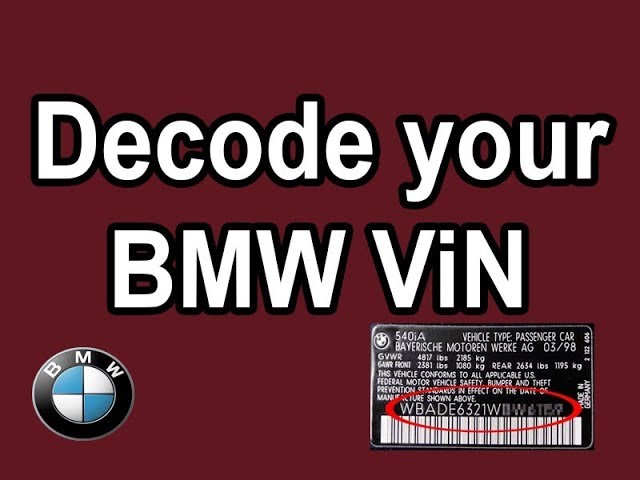
Where to Find Your BMW VIN Number
There are five places a BMW VIN typically appears. Knowing all of them helps you confirm the VIN on the paperwork matches the VIN stamped on the car itself.
Your BMW’s VIN can be found in a few common places. Check the dashboard near the windshield. You can also look inside the driver’s side door frame. Another spot to find it is on the vehicle registration papers. Here are some tips for different BMW models:
- Lower driver’s-side corner of the windshield, visible from outside
- Driver’s-side door jamb sticker (check for a matching VIN and production date)
- Under the hood, stamped on the strut tower or firewall
- On the vehicle registration, title, and insurance documents
- On the engine block or transmission housing on many models
These locations make it easy to find your VIN!
Where can I find my BMW VIN?
You can find your BMW VIN on the dashboard, inside the door frame, or on your registration papers. Make sure to check these spots so you can decode your BMW VIN quickly!
Breaking Down the VIN Structure

Explanation of the 17-character format of a VIN. Detailed description of each section of the VIN (WMI, VDS, VIS).
A VIN, or Vehicle Identification Number, is like your car’s social security number. It has 17 characters that tell you everything about your car. Let’s break it down. First, we have the WMI, or World Manufacturer Identifier (positions 1-3). This shows who made the car. Next comes the VDS, or Vehicle Descriptor Section (positions 4-8), which describes the car’s attributes like its model, body style, and engine. Position 9 is the check digit. Finally, the VIS, or Vehicle Identifier Section (positions 10-17), covers the model year, assembly plant, and the unique serial number.
| Section | Purpose |
|---|---|
| WMI | Identifies the manufacturer |
| VDS | Describes the vehicle’s features |
| VIS | Provides unique identification info |
Decoding the World Manufacturer Identifier (WMI)
Information on how to interpret the first three characters of the VIN. Significance of identifying the manufacturer and country of origin.
The first three characters of your VIN make up the World Manufacturer Identifier (WMI). The first character shows the country where the car was built. For BMW, that is almost always ‘W’ for Germany, though some X models built in South Carolina start with ‘5’. The next two characters identify the manufacturer and, for BMW, the brand. Here is what the most common BMW WMIs mean:
- WBA – BMW passenger cars (Germany)
- WBS – BMW M models (Germany)
- WBY – BMW i electric and hybrid models (Germany)
- 5UX – BMW X models built in Spartanburg, South Carolina
- WMW – MINI (built in Oxford, UK or other MINI plants)
- SCA – Rolls-Royce (Goodwood, UK)
Spotting the WMI first tells you immediately whether you are looking at a BMW, a MINI, or a Rolls-Royce, and roughly where it was assembled.
Position 9: The Check Digit, With a Worked Example
The 9th character is a check digit. It is calculated from the other 16 characters and is used to validate that the VIN is genuine and not mistyped. Here is how the math works, using a simplified example.
Each letter is assigned a number: A=1, B=2, C=3, D=4, E=5, F=6, G=7, H=8, J=1, K=2, L=3, M=4, N=5, P=7, R=9, S=2, T=3, U=4, V=5, W=6, X=7, Y=8, Z=9. Numbers keep their own value.
Each of the 17 positions has a weight: 8, 7, 6, 5, 4, 3, 2, 10, 0, 9, 8, 7, 6, 5, 4, 3, 2. Multiply each character’s value by its position weight, add the results, then divide by 11. The remainder is the check digit. If the remainder is 10, the check digit is the letter ‘X’.
If the calculated digit does not match position 9, either the VIN was mistyped or the VIN plate may have been altered. This is one of the fastest ways to spot a cloned VIN.
| WMI Character | Country | Manufacturer |
|---|---|---|
| W | Germany | BMW |
| J | Japan | Toyota |
| 1 | USA | Ford |
Understanding the Vehicle Descriptor Section (VDS)

Insights into the fourth to eighth characters and what they reveal about the vehicle. Explanation of the vehicle attributes, such as model, body style, and engine type.
The fourth to eighth characters of your BMW’s VIN, the Vehicle Descriptor Section, describe the car itself. These five characters encode the model series, body style, engine, and restraint system. They do not map cleanly to a single ‘model code’ the way many people assume, which is why the same 3 Series can carry several different VDS combinations depending on engine and market. Here is what each position generally covers:
- Position 4 – Model or series family
- Position 5 – Body style and engine variant
- Position 6 – Restraint system and related equipment
- Positions 7-8 – Further model, engine, and trim detail
Because these characters are manufacturer-specific, the only reliable way to read them is against a BMW build sheet or a decoder that maps them to your exact model year.
| Characters | Description |
|---|---|
| 4th | Model |
| 5th | Body Style |
| 6th – 8th | Engine Type |
This fun section helps you understand what makes your BMW tick! Who knew decoding your car could be so thrilling? So go ahead and impress your friends with your newfound knowledge!
Interpreting the Vehicle Identifier Section (VIS)
Breakdown of the last nine characters of the VIN. Information on how to identify the vehicle’s production year and plant of manufacture.
The last nine characters of a VIN, the Vehicle Identifier Section, carry the model year, the assembly plant, and the car’s unique serial number. Position 9 is the check digit, position 10 is the model year, position 11 is the plant, and positions 12-17 are the sequential production number. Here is the breakdown:
- Position 9 – Check digit (a math-based validation character)
- Position 10 – Model year code
- Position 11 – Assembly plant code
- Positions 12-17 – Unique serial number for that vehicle
- First character – Make (e.g., BMW)
- Next five – Model and unique features
- Last character – Production year
For plant details, you can check the VIN. It helps you learn where your car was manufactured. Use this knowledge to understand your BMW better.
How can I tell my car’s production year?
The 10th character of the VIN is the model year. The code cycles through letters and numbers, skipping I, O, Q, U, and Z to avoid confusion. For example, ‘F’ is 2015, ‘G’ is 2016, ‘H’ is 2017, ‘J’ is 2018, and ‘K’ is 2019. The letter ‘A’ can mean 1980 or 2010 depending on the rest of the VIN, so always confirm with the full sequence.
VIN vs Chassis Code: Why They Are Not the Same
BMW enthusiasts often talk about chassis codes like E90, F30, or G20. These are not the same as the VIN. A chassis code identifies a generation and platform, while the VIN identifies one specific car. The same chassis code covers thousands of vehicles with different engines, trims, and options.
| Chassis Code | Common Model | Typical Years |
|---|---|---|
| E46 | 3 Series | 1998-2006 |
| E90 | 3 Series sedan | 2005-2012 |
| F30 | 3 Series sedan | 2012-2019 |
| G20 | 3 Series sedan | 2019-present |
| E70 | X5 | 2007-2013 |
| F15 | X5 | 2014-2018 |
You cannot read the chassis code directly from the VIN. You get it by decoding the VDS and matching it to BMW’s build data, or by checking the model year and body style together.
Common Misconceptions About BMW VINs

Debunking myths surrounding VIN decoding. Clarifying what VINs do and do not provide in terms of vehicle information.
Many people think a BMW’s VIN can reveal its complete history. That is not true. A VIN identifies the car and its factory specification, but it does not contain accident records, service history, or owner details on its own. Those come from separate databases that are queried using the VIN. Here is a quick look at what a VIN does and does not tell you:
| Common Myth | Truth |
|---|---|
| VINs show accident history. | Not at all! They only provide basic info. |
| All VINs are 17 characters long. | Many older BMWs have shorter VINs. |
| VINs can predict a vehicle’s value. | They can’t; that depends on market demand. |
Remember, while VINs are handy, they don’t spill all the secrets about your car! Think of them as a fun mystery to solve, not a full biography.
Using Online Tools for VIN Decoding
Recommendations for reliable online VIN decoder tools. Guidance on how to use these tools effectively.
Online VIN decoders fall into two broad groups: free tools that return basic factory data, and paid tools that pull history records from insurers, auctions, and government databases. Free decoders are usually enough to confirm the model, engine, and factory options. Paid tools are what you need for accident, salvage, and title checks. Here is how the two compare for a BMW specifically:
To use these tools, simply enter your VIN and click the “decode” button—no magic wands needed! It’s as easy as pie, and who doesn’t love pie? By decoding your VIN, you can learn about your car’s past, options, and more. So, get decoding and uncover the mysteries of your BMW!
Best Practices for Keeping Your VIN Secure
Tips on protecting your VIN from theft or misuse. Strategies for maintaining privacy when sharing VIN information.

Keeping your VIN safe matters because a VIN is the key to your car’s identity. A thief who has your VIN can order a replacement key, clone your VIN onto a stolen car, or misrepresent a salvage vehicle as clean. Treat it like a password. Share it only with buyers, insurers, or shops that genuinely need it, and never post a photo of your dashboard or door jamb sticker publicly.
What to Do When the Decoder Output Does Not Match the Car
Sometimes a decoder returns a model, engine, or option list that does not match what is physically in front of you. This is more common than people expect, and it usually means one of four things:
- The VIN was entered incorrectly, so re-check every character against the door jamb sticker.
- The car has been modified after production, so the decoder is showing the factory spec, not the current build.
- The VIN plate or sticker has been replaced or altered, which can indicate a cloned or salvage vehicle.
- The decoder database is incomplete for that model year or market.
If the VIN on the dashboard does not match the VIN on the door jamb, the engine, or the paperwork, stop and investigate before buying. Mismatched VINs are one of the strongest warning signs of a stolen or rebuilt vehicle.
| Tip | Description |
|---|---|
| Keep it private | Don’t share your VIN on social media or public forums. |
| Use secure storage | Store your VIN in a locked place, away from prying eyes. |
| Limit sharing | Only share your VIN with trusted individuals or businesses. |
Conclusion
In summary, decoding your BMW VIN is simple once you know the 17-character structure. You can read the WMI, VDS, check digit, model year, plant, and serial number yourself, then confirm the details with a decoder or build sheet. Start by finding the VIN in all five locations and checking that they match. From there, use a free decoder for factory data and a paid history report for accident and title checks. Happy decoding!
FAQs
What Does Each Section Of A BMW VIN Number Represent?
A BMW VIN has 17 characters. Positions 1-3 are the WMI, showing country and manufacturer (WBA for BMW cars, WBS for M models, 5UX for US-built X models). Positions 4-8 describe the model, body, and engine. Position 9 is the check digit. Position 10 is the model year, position 11 is the assembly plant, and positions 12-17 are the unique serial number.
How Can I Identify The Model Year Of My BMW Using The Vin?
Look at the 10th character of the VIN. It is a letter or number that maps to a model year, skipping I, O, Q, U, and Z. For example, ‘F’ is 2015, ‘G’ is 2016, ‘H’ is 2017, ‘J’ is 2018, and ‘K’ is 2019. Because the code repeats every 30 years, confirm the year against the door jamb sticker or a decoder if the car is older.
Where Can I Find The Vin On My Bmw Vehicle?
You can find the VIN, or Vehicle Identification Number, on your BMW in a few places. Look on the driver’s side dashboard near the window. You might also find it on the driver’s side door frame when you open the door. Sometimes, it’s on the car’s registration papers too.
Are There Online Tools Or Resources Available To Decode Bmw Vin Numbers?
Yes, there are online tools that help you decode BMW VINs. A VIN is a Vehicle Identification Number, which is like a special name for a car. You can find websites where you just type in the VIN, and it tells you about the car’s details. These tools are easy to use and can give you information quickly!
How Can I Use The Vin To Check The Vehicle History Of My BMW?
You can check your BMW’s history using the VIN. First, find the VIN in all five locations and confirm they match. Then run it through a paid history service that pulls accident, salvage, title, and odometer records. A free decoder will only give you factory specification, not history, so use both if you want the full picture.
Decoding MINI and Rolls-Royce VINs
MINI and Rolls-Royce are both part of the BMW Group, and their VINs follow the same 17-character structure, but the WMIs are different. MINI VINs commonly start with WMW, while Rolls-Royce VINs start with SCA. The rest of the structure works the same way: positions 4-8 describe the model and engine, position 9 is the check digit, position 10 is the model year, position 11 is the plant, and positions 12-17 are the serial number.
If you are decoding a MINI, use a MINI-specific decoder rather than a BMW one, because the model and option codes differ. For Rolls-Royce, the same applies. The manual method still works, but the model code tables are brand-specific.
Related posts:
 ZF 8HP Transmission Problems: Variants, Costs & Fixes
 Which BMW Has 3 Rows? X7, iX, and X5 Explained
 BMW Stalls When Stopping: Causes, Codes, Costs & Fixes
 BMW Garage Door Opener: HomeLink Programming & Fixes
 What BMW Has the B58 Engine? Full Model List, Years, and Outputs
 BMW Restraint System Malfunction: Causes, Codes & Fixes
 How To Tell If BMW Has Adaptive Suspension: VIN, iDrive & Visual Checks
 How To Check BMW Transmission Fluid Level (Dipstick & Sealed)
 How To Connect To BMW WiFi: Step-By-Step Guide (2025)
 Bmw Leaking Coolant But Not Overheating: Causes & Fixes
 BMW Limp Mode: Causes, OBD-II Codes & Fixes Explained
 F150 Jump Seat Console Organizer: Fitment Chart & Top Picks