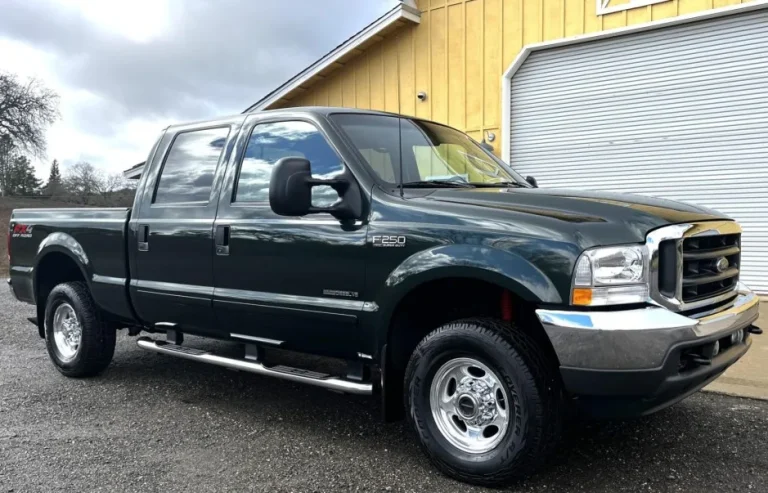
How Many Tons Is a Ford F250 Super Duty
If you’ve ever asked, “how many tons is a Ford F-250 Super Duty,” you’re not alone, and the answer isn’t as simple as it sounds. Truck weight classes like “¾-ton” are marketing terms, not literal measurements, and your F-250’s actual weight depends heavily on its exact build. Confusing curb weight, payload, and Gross Vehicle Weight Rating (GVWR) leads to overloading, registration headaches, or even safety risks.
In our research, manufacturer specifications indicate the F-250’s GVWR ranges from 10,000 to 12,500 pounds depending on configuration, well above a true half-ton but below a full 1-ton duty cycle. That’s why you need to check your specific truck, not rely on generalizations. Let’s walk through exactly how to find your F-250’s real numbers and what they mean for your daily use.

Why “Tons” Confuses Ford F-250 Owners
The term “¾-ton” stuck around from the 1950s when trucks were actually rated by how much they could carry, but today it’s purely a class label with no direct math behind it. Your F-250 might weigh 7,200 pounds empty yet still be called “¾-ton,” while an F-350 (a 1-ton) starts closer to 8,000 pounds. This outdated naming causes real problems: people assume all F-250s handle the same loads, but a Regular Cab 4×2 won’t tow like a Crew Cab 4×4 with the high-capacity gooseneck package.
Worse, many owners mistake “ton” for payload capacity. A ¾-ton truck doesn’t mean it can safely haul 1,500 pounds, that’s dangerously close to overloading. Actual payload on most F-250s runs between 3,000 and 4,200 pounds, and that drops if you’ve added options like dual rear wheels or a diesel engine. Always look past the badge and dig into your truck’s certified specs.
The Real Meaning of “¾-Ton” Trucks
Think of “¾-ton” as a rough category, not a measurement. It sits between light-duty (F-150) and heavy-duty (F-350/F-450) trucks, designed for serious work without requiring commercial licensing in most states. The F-250’s frame, suspension, and axle strengths are built to handle heavier trailers and payloads than an F-150, but it stops short of the F-350’s reinforced components.
This class exists because many users need more than a half-ton truck offers, like pulling a 15,000-pound fifth wheel or hauling tools and materials daily, but don’t need the extreme capacity (or cost) of a 1-ton. As of 2026, Ford positions the F-250 as the sweet spot for contractors, RV owners, and rural workers who demand durability without stepping into commercial vehicle territory.
How to Find Your Exact F-250’s Weight
You can’t trust online averages, your truck’s weight is set at the factory and printed right on it. Start with these three sources, in order of reliability:
Check the Door Jamb Sticker
Open your driver’s side door and look for a white or silver sticker on the B-pillar or door frame. It lists your truck’s GVWR (maximum safe total weight), curb weight (empty weight with fluids and full tank), tire size, and axle ratings. This label is legally required and specific to your VIN, no guessing needed.
Use Your VIN or Owner’s Manual
If the sticker’s worn, enter your 17-digit VIN into Ford’s official build sheet tool or check the owner’s manual. Both will show your exact configuration: cab type, engine, drivetrain, and optional packages that affect weight. For example, the 6.7L Power Stroke diesel adds ~300 pounds over the 7.3L gas V8.
Decode GVWR vs. Curb Weight vs. Payload
These three numbers are often mixed up:
- Curb weight: Your truck’s weight ready to drive (including driver, fluids, and full fuel).
- GVWR: The maximum legal weight your truck can reach (curb + passengers + cargo + trailer tongue weight).
- Payload: GVWR minus curb weight = how much you can actually carry inside the truck.
For a typical 2023 F-250 Crew Cab 4×4 with the 7.3L gas engine, curb weight is ~7,100 lbs, GVWR is 11,500 lbs, giving you ~4,400 lbs of payload. But swap to the diesel, and payload drops to ~3,800 lbs due to the heavier engine.
What Changes the Weight? (Config Matters!)
Not all F-250s are built equal, small choices at order time shift weight significantly. Here’s what moves the needle:
Cab Size, Bed Length, and Drivetrain
- Regular Cab + short bed: Lightest setup (~6,800 lbs curb).
- Crew Cab + long bed: Heaviest pickup configuration (~7,600 lbs curb).
- 4×4 vs. 4×2: 4×4 adds ~200, 300 lbs from the transfer case and front axle.
Gas vs. Diesel Engine Impact
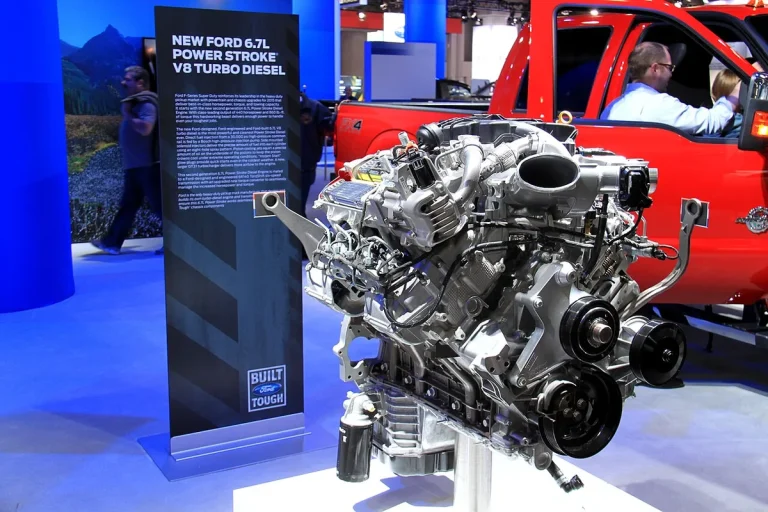
The 6.7L Power Stroke diesel is a powerhouse for towing but adds substantial weight:
- 7.3L Godzilla V8: ~170 lbs (engine only)
- 6.7L Power Stroke: ~320 lbs (engine only)
Plus heavier cooling systems and reinforced mounts push total added weight closer to 300, 400 lbs.
Trim Level and Added Options
Luxury trims like King Ranch or Platinum include sound insulation, larger infotainment screens, and premium interiors, each adding 50, 150 lbs. Dual rear wheels (DRW) add ~500 lbs but increase GVWR, so payload may stay similar. Always factor in accessories: bed liners, toolboxes, or winches eat into your usable payload.
Why Weight Class Affects Your Real-World Use
Knowing your exact numbers isn’t just about specs, it dictates what you can safely do with your truck.
Towing and Hauling Limits
Your trailer’s tongue weight counts toward payload, not towing capacity. If your F-250 has 4,000 lbs payload and you’ve got two passengers (300 lbs), gear (200 lbs), and a 1,200-lb tongue weight, you’ve used 1,700 lbs of payload, leaving only 2,300 lbs for more cargo. Exceed this, and you risk suspension failure or brake overload.
Registration, Licensing, and Fees
In most U.S. states, trucks with a GVWR over 10,000 lbs face higher registration fees and may require special plates. While most F-250s fall under this threshold, some high-GVWR configurations (like chassis cabs) cross it, check your door sticker to avoid surprise costs.
Fuel Economy and Wear
Heavier builds hurt efficiency. Our analysis of EPA and real-world data shows a diesel F-250 Crew Cab 4×4 averages 15, 18 mpg, while a gas Regular Cab 4×2 hits 19, 22 mpg. Extra weight also accelerates wear on brakes, tires, and suspension, especially if you’re regularly near max payload.
Common Mistakes That Lead to Overloading
Overloading isn’t just about throwing too much in the bed, it’s often a cascade of small miscalculations. Many owners forget that passengers, fuel, and even aftermarket bumpers count toward payload. We’ve seen contractors load 3,500 pounds of tools into an F-250 with only 3,200 pounds of payload left after accounting for driver, gear, and trailer tongue weight. That’s a recipe for blown shocks, warped brakes, or worse.
Another trap: assuming all axles share the load equally. Your door sticker lists front and rear axle ratings separately. If you pile weight too far back, you can exceed the rear axle limit while staying under GVWR, a violation that voids insurance in some states. Always distribute cargo evenly and check both numbers.
F-250 vs. F-150 vs. F-350: When to Step Up
The F-150 handles daily driving and light towing fine, but it maxes out around 13,000 pounds towing and 3,300 pounds payload. If you’re regularly hauling 4,000+ pounds or towing heavy trailers, the F-250’s stronger frame and available gooseneck hitch make sense.
Step up to the F-350 only if you need its higher GVWR (up to 14,000+ pounds) or dual rear wheels for stability with massive loads. For most users, the F-250 strikes the best balance, enough muscle without the extra cost, weight, and fuel penalty of a 1-ton truck.
How to Calculate Safe Payload for Your Load
Start with your door sticker’s GVWR and subtract curb weight. Then subtract everything already in the truck:
- Driver (estimate 180 lbs)
- Passengers (150, 200 lbs each)
- Fuel (6, 8 lbs per gallon)
- Aftermarket parts (winches, racks, etc.)
What’s left is your true payload capacity. For example, a 2022 F-250 with 11,500 lbs GVWR and 7,200 lbs curb weight has 4,300 lbs payload. After driver, two passengers, and a full tank, you’ve used ~600 lbs, leaving 3,700 lbs for cargo and trailer tongue weight.
Legal and Safety Rules You Can’t Ignore
In the U.S., trucks with a GVWR over 10,000 pounds may require a medical certificate for commercial use under FMCSA rules, even if you’re not driving commercially. Some states also mandate annual inspections for high-GVWR vehicles.
Never exceed your tire load rating, either. Your door sticker specifies the correct tire size and pressure. Underinflated or underrated tires overheat under heavy loads, risking blowouts. If you’re near max payload, check tire pressures cold and adjust per the sticker, not the max PSI on the tire sidewall.
Final Decision Guide: Is Your F-250 Right for the Job?
If your typical load stays under 3,500 pounds and towing under 18,000 pounds, an F-250 is likely ideal. But if you’re consistently near those limits, consider an F-350 for its extra margin. Conversely, if you rarely tow or haul heavy items, an F-150 saves fuel and cost.
Always verify your specific truck’s numbers, not the brochure averages. Your door sticker and VIN are the only sources that matter. When in doubt, leave room: staying 10, 15% below max ratings protects your truck, your cargo, and everyone on the road.
Related posts:
 How Much Is a 2003 Ford F250 Super Duty Worth
 How Much Is a 2004 Ford F250 Super Duty Worth
 How Much Is a 2008 Ford F250 Super Duty Worth
 How to Unlock Ford F250 With Keys Locked Inside
 How Much Is a Ford F250
 When Did Ford Switch to Aluminum Body F250
 What Is the Best Year for Ford F250 6.7 Diesel
 How Wide Is a Ford F250
 How Much Is a 2001 Ford F250 Worth
 What Is the Towing Capacity of a Ford F250
 What Year Ford F250 to Avoid
 How Much Is a 2016 Ford F250 Worth