Ford F150 PCM Reset Code: The Complete Expert Guide to Doing It Right
What a Ford F-150 PCM Reset Actually Does (And Doesn’t Fix)
Your truck starts shifting hard. The idle hunts at stoplights. Fuel economy drops two miles per gallon overnight. You search for a ford f150 pcm reset code and find a dozen forum posts telling you to yank the negative battery cable for 30 minutes.
That advice isn’t wrong. It’s just incomplete. A PCM reset clears adaptive memory, which is the learned data your truck accumulated over thousands of miles of driving. Sometimes that data gets corrupted by a bad sensor, a weak battery, or a repair that changed how the engine breathes. Clearing it forces the powertrain control module to relearn from scratch.

TAKOPEN
TAKOPEN Auto Start Stop Eliminator for 2021-2026…
- SMART MEMORY MODE ACTIVATED: Automatically maintains your preferred setting to disable the engine stop-start system each time you…
- QUALITY ASSURED: This device is FCC Compliant for electromagnetic compatibility, ensuring it does not interfere with your vehicle'…
- SIMPLE PLUG AND PLAY: Designed for a quick 10-minute installation with no wire cutting or vehicle programming required. The device…
But here’s the part most guides skip: a reset doesn’t fix hardware. If your PCM is failing, if a coil pack is dying, or if your transmission has a mechanical problem, erasing adaptive memory just hides the symptom for a few days. The code comes back. The hard shift returns. You’ve wasted an afternoon.
This guide walks through the exact reset procedure for every F-150 generation, the codes that justify a reset, the drive cycle specs you need to complete relearn, and the situations where you should stop and call a dealer instead.
One thing worth addressing before we go further: if your frustration with the truck stems from the auto start-stop system constantly killing the engine at red lights, that’s a separate issue. The TAKOPEN Auto Start Stop Eliminator for 2026-2026 Ford F150 plugs into the factory harness and remembers your preference to keep the engine running. It’s a 10-minute install with no wire cutting. Worth knowing about if the stop-start behavior is what pushed you toward resetting things in the first place.
PCM vs ECM vs TCM vs BCM: Know What You’re Actually Resetting
Ford uses several control modules, and people mix them up constantly. Here’s the breakdown.
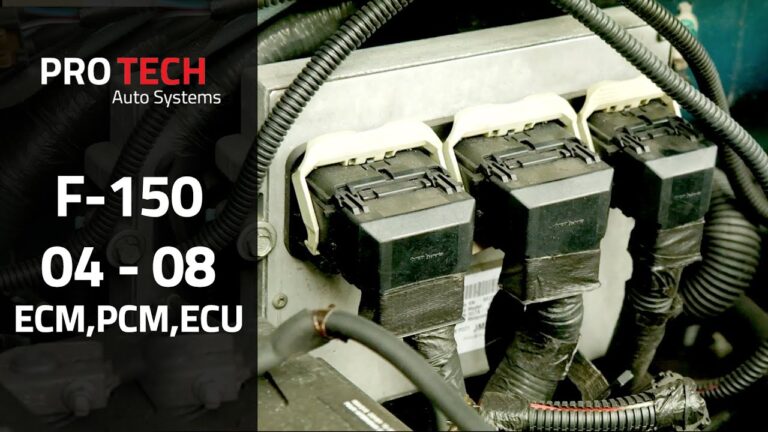
PCM (Powertrain Control Module) — The main computer. On modern F-150s, it handles engine management, fuel delivery, ignition timing, and transmission control in one unit. Older trucks (pre-2026) often had a separate ECM and TCM.
ECM (Engine Control Module) — Engine-only functions. On older F-150s, this was a separate box. On 2026+ trucks, Ford merged it into the PCM.
TCM (Transmission Control Module) — Shift logic and adaptive strategy. On 2026+ F-150s with the 6R80 transmission, the TCM is inside the transmission and communicates over CAN bus. You can’t reset it by pulling a fuse.
BCM (Body Control Module) — Lights, windows, door locks, PATS (Passive Anti-Theft System). Resetting the BCM is a different procedure entirely and can trigger a theft relearn.
When someone says “reset the PCM,” they usually mean clearing the keep-alive memory (KAM) and adaptive learning tables inside the powertrain module. That’s what we’re covering here.
Adaptive Memory, KAM, and Fuel Trims Explained
Adaptive memory is your truck’s way of compensating for wear and environmental conditions. The PCM watches oxygen sensor feedback and adjusts fuel trim — the percentage of fuel added or subtracted from the base map.
Short-term fuel trim (STFT) adjusts in real time. Long-term fuel trim (LTFT) stores those adjustments permanently. A healthy LTFT sits between plus or minus 10 percent. If yours reads plus 25 percent, the PCM is dumping fuel to compensate for a vacuum leak or dying sensor.
KAM stores LTFT, idle learned values, transmission shift pressure adaptations, and throttle body position relearn data. Pull power from the PCM for long enough, and KAM wipes. The truck reverts to factory base maps.
That’s the reset. Nothing magical. Just erasing learned corrections.
When to Reset Your F-150 PCM — And When Never To
A reset makes sense in specific situations. It’s a bad idea in others.
Good reasons to reset:
- You replaced a sensor (MAF, O2, throttle body) and the truck still runs like it did before the repair
- You replaced the battery and the idle is rough because idle relearn data was lost mid-adaptation
- A repair shop cleared codes but didn’t reset adaptive memory, and the transmission still shifts like it’s confused
- You bought a used truck and want a clean baseline for diagnostics
- You installed a cold air intake or exhaust and the fuel trims are skewed
Bad reasons to reset:
- You have an active check engine light and haven’t read the codes yet
- The truck won’t start and you’re guessing
- You’re trying to pass an emissions test tomorrow (resetting clears readiness monitors)
- You think it’ll fix a mechanical misfire
Warning Signs: Rough Idle, Hard Shifts, Poor MPG
Rough idle after a battery change is the classic reset scenario. The PCM lost idle learned values and defaults to a base idle speed. It’ll relearn on its own in 20-50 miles, but a reset speeds that up.
Hard shifts on a 6R80 or 10R80 transmission often point to adaptive strategy loss. The TCM learned your driving style and adjusted shift pressure accordingly. Wipe that memory and the first 100 miles feel clunky. That’s normal. It smooths out.
Poor fuel economy with no codes? Check LTFT first. If it’s within spec, a reset won’t help. If it’s maxed out at plus or minus 25 percent, you have a real problem a reset won’t solve.
Critical: Do Not Reset Before Reading Codes
This is the mistake that costs people hundreds of dollars.
Your PCM stores freeze frame data when it sets a diagnostic trouble code. That data includes engine RPM, coolant temp, vehicle speed, and fuel trim at the exact moment the fault triggered. It’s diagnostic gold.
Disconnect the battery before reading codes, and you erase all of it. The code clears. The freeze frame vanishes. Now you’re driving a truck with an intermittent problem and zero evidence of what caused it.
Read codes first. Write them down. Then decide if a reset is appropriate.
If you don’t own a scanner yet, the best code reader for F-150 owners starts around the price of two oil changes and pays for itself the first time you avoid a dealer diagnostic fee.
Preparation: Tools, Safety, and Data You Must Save
Before you touch anything, gather these items:
- OBD2 scanner (or FORScan with an ELM327 adapter)
- 10mm wrench or socket for the battery terminal
- Memory saver (optional but recommended if you want to preserve radio presets and clock settings)
- Notebook or phone for writing down codes and freeze frame data
- Torque wrench if you’re disconnecting anything beyond the battery
Save these before resetting:
- All stored and pending DTCs
- Freeze frame data for each code
- Current LTFT values at idle and at 2500 RPM
- Transmission adaptive strategy values if your scanner reads them
If your truck has PATS (all F-150s since 1999), disconnecting the battery won’t erase key programming. PATS lives in the BCM and instrument cluster, not the PCM. But if you’re swapping the PCM itself, you’ll need dealer-level tools to reprogram PATS. That’s a different job.
Method 1: Battery Disconnect Hard Reset (Step-by-Step)
This is the free method. It works on every F-150 from 1997 to present. It’s also the slowest.
- Turn off the ignition. Remove the key. Close all doors.
- Loosen the negative battery terminal with a 10mm wrench.
- Slide the cable off the post. Tuck it aside so it can’t touch metal.
- Wait. Not 5 minutes. Not 15. A full 30 minutes minimum. Some PCMs hold KAM for up to an hour.
- For a faster, more thorough wipe, touch the negative cable end to the positive battery post for 10 seconds. This discharges capacitors that hold residual voltage.
- Reconnect the negative cable. Tighten to snug — don’t gorilla it.
- Start the truck. Let it idle for 5 minutes without touching the throttle.
Capacitor Discharge Procedure
Capacitors inside the PCM hold voltage after battery disconnect. That residual charge can keep KAM alive for hours in some cases.
The fix: after removing the negative cable, bridge the negative cable end to the positive battery post for 10-15 seconds. Use a jumper wire or just hold the cable end against the post. You’ll see a small spark. That’s normal.
Don’t do this with the positive cable still connected to the battery. Negative cable to positive post only. The battery’s positive terminal stays connected to the vehicle.
What to Expect Immediately After
The truck will idle high — usually 1100-1400 RPM — for the first few minutes. That’s the PCM running a base idle strategy while it waits for sensor feedback.
You’ll also notice:
- Rough idle for the first 10-20 miles
- Firm or delayed shifts for the first 50-100 miles
- Slightly worse fuel economy until LTFT rebuilds
- Radio presets and clock reset (unless you used a memory saver)
- All emissions readiness monitors showing “not ready”
None of this means something’s broken. It’s the relearn process.
Method 2: OBD2 Scanner Soft Reset / KAM Clear
A scanner reset is faster and cleaner than pulling the battery. You keep radio presets, clock settings, and PATS data. You also get to read codes before clearing anything.
Not every scanner can clear KAM. Generic code readers clear DTCs but leave adaptive memory intact. You need a tool with Ford-specific bidirectional controls.
FORScan, Autel, and Launch Menu Paths
FORScan (Windows, free software + $30 ELM327 adapter):
- Connect adapter to OBD2 port under the dash
- Open FORScan, select your vehicle profile
- Go to Configuration and Programming tab
- Select PCM module
- Choose “Reset KAM” or “Clear Adaptive Tables”
- Confirm and wait for the module to reboot
Autel MaxiCOM / MaxiSys:
- Select Diagnostics > Ford > F-150 > year
- Choose Control Modules > PCM
- Select Special Functions > Reset Adaptive Memory
- Follow on-screen prompts
Launch X431 series:
- Diagnose > Ford > Auto Detect
- System Selection > PCM
- Special Function > Clear KAM
- Execute and cycle ignition when prompted
Menu paths vary by software version. If you can’t find KAM reset, look for “adaptive learning reset” or “PCM reset” — different tools use different labels.
Method 3: PCM Reprogramming and Reflash (When Reset Fails)
A reset clears learned data. A reflash replaces the software itself.
You need a reflash when:
- Ford released a TSB with updated calibration for your truck
- The PCM has corrupted firmware (rare, but it happens)
- You replaced the PCM with a used unit
- A reset doesn’t resolve a persistent driveability issue and all hardware checks out
Reflashing requires a J2534 pass-through device and a subscription to Ford’s IDS software. Independent shops charge $100-$200 for the service. Dealers charge $150-$250 depending on the TSB.
Don’t attempt a reflash with a cheap clone tool. Interrupting a flash mid-write bricks the PCM. A bricked module means towing and a $600-$1200 replacement.
The Ford F-150 Drive Cycle: Exact Relearn Steps
“Drive normally for a while” is useless advice. Here’s the actual drive cycle Ford uses to set readiness monitors and complete adaptive relearn.
You need 20-30 minutes of uninterrupted driving. Find a route with a mix of city streets and highway.
Idle, City, Highway, and Decel Phases
- Cold start idle: Start the truck cold. Let it idle 3-5 minutes with no accessories on. Coolant temp should reach at least 150°F.
- City phase: Drive 5 miles at 25-45 MPH with several complete stops. Accelerate gently — no more than 1/4 throttle.
- Highway phase: Accelerate to 55-65 MPH. Hold steady for 8-10 miles. Coolant must reach 195-215°F.
- Decel phase: From 55 MPH, release the throttle and coast down to 20 MPH without braking. Repeat 3 times. This sets fuel cut and misfire monitors.
- Idle check: Park, leave the engine running, and let it idle 5 minutes in gear with your foot on the brake.
Total time: 25-40 minutes depending on traffic. Don’t shut the engine off mid-cycle. A key cycle between phases resets some monitor progress.
Emissions Readiness Monitors Timeline
After a reset, all monitors show “not ready.” Here’s how long they take to set:
| Monitor | Typical Time to Set | Conditions Required |
|---|---|---|
| Misfire | 5-10 minutes | Steady cruise, varied RPM |
| Fuel System | 10-20 minutes | Closed loop, stable coolant temp |
| O2 Sensor | 15-30 minutes | Multiple decel events from 55+ MPH |
| O2 Heater | 5-15 minutes | Cold start, then warm-up |
| Catalyst | 30-60 minutes | Sustained 55 MPH for 10+ miles |
| EVAP | 1-7 days | Fuel level 15-85%, temp 40-95°F, no refueling |
| EGR | 15-30 minutes | Steady cruise with light load |
If you have a smog check coming up, don’t reset the PCM within two weeks of the test. EVAP can take a full week of normal driving to set. Failing a smog check for “not ready” monitors means paying for a retest.
Year-Specific Notes: 1997-2026, 2026-2026, 2026-2026, 2026-Present
Ford changed PCM behavior across generations. Here’s what matters for each.
1997-2026 (10th gen): Separate ECM and TCM on some models. Battery disconnect resets both. Idle relearn takes 10-15 minutes of idling. No CAN bus — modules communicate over SCP or ISO 9141. Generic OBD2 scanners read codes but can’t clear KAM. You need a Ford-specific tool or the battery method.
2026-2026 (11th gen): PCM and TCM merged into one module. CAN bus introduced in 2026. Throttle body relearn became a thing — expect a high idle for the first few minutes after reset. FORScan supports these years well.
2026-2026 (12th gen): 6R80 transmission introduced in 2026. TCM lives inside the transmission but is controlled by the PCM. Adaptive shift strategy is more aggressive. After a reset, expect 100-200 miles before shifts feel normal again. Some owners hate this period. It’s temporary.
2026-present (13th gen and newer): 10R80 transmission on 2026+ trucks. PCM controls more systems than ever — auto start-stop, electronic parking brake, adaptive cruise. Battery disconnect resets everything, including your drive mode preferences. The 2026+ trucks with Powerboost hybrid systems have a completely different architecture. Don’t pull the battery on a hybrid without reading the service manual first.
Troubleshooting: PCM Not Responding, No Start, PATS Issues
Things go wrong. Here’s a checklist.
PCM not responding to scanner:
- Check fuse F13 (2026+) or equivalent PCM fuse in the under-hood box
- Verify the OBD2 adapter is seated fully — loose connections cause this constantly
- Try a different scan tool. Cheap ELM327 clones fail on Ford CAN bus more often than you’d think
- Check for CAN bus communication errors — a shorted wire in the network kills PCM communication
No start after reset:
- Check battery voltage. Below 12.2V means the PCM won’t boot reliably
- Verify the ground cable is tight. A loose ground causes intermittent no-starts
- Wait 10 minutes with the key in the ON position — some modules need time to reinitialize
PATS / theft light flashing:
- Battery disconnect doesn’t erase PATS. If the theft light flashes, something else happened
- Try a different key. The transponder chip may have failed
- If both keys fail, you need dealer-level PATS reprogramming. There’s no DIY workaround on 2026+ trucks
If you’re dealing with a theft system issue specifically, this guide on resetting anti-theft system covers the PATS relearn procedure in detail.
Cost: DIY vs Dealer vs Replacement PCM
Here’s what each option actually costs.
| Method | Cost Range | Time | Best For |
|---|---|---|---|
| Battery disconnect | $0 | 45 min + drive cycle | Post-repair relearn, DIY diagnostics |
| OBD2 scanner reset | $30-$200 (tool cost) | 10 min + drive cycle | Preserving settings, reading codes first |
| Dealer reset/reflash | $100-$250 | 1-2 hours | TSB calibration updates, persistent issues |
| Independent shop reflash | $75-$150 | 1 hour | Cheaper than dealer for same service |
| Replacement PCM (new) | $600-$1,200 | 2-4 hours + programming | Confirmed PCM failure |
| Replacement PCM (used) | $150-$400 | 2-4 hours + programming | Budget option, requires PATS relearn |
Used PCMs are tempting. Don’t go there unless you have access to dealer-level programming tools. PATS won’t recognize a used PCM without a relearn, and the truck won’t start until it does.
One more thing: a dealer reset is rarely just a reset. They’ll run a full diagnostic, which is where the $150-$250 goes. If you’ve already read codes and know what you need, an independent shop with IDS access does the same reflash for less.
Questions F-150 Owners Actually Ask
Will resetting my PCM clear my check engine light permanently?
No. A reset clears the code, but if the underlying fault is still present, the light comes back. Sometimes in 5 miles. Sometimes in 50. The PCM runs a readiness test on each monitor, and when a fault triggers twice in a row, the light returns. If you want the light gone for good, fix the cause. This guide on resetting check engine light walks through the diagnostic side.
How long does the F-150 PCM take to relearn after a reset?
Idle relearn takes 10-20 minutes of idling plus 20-50 miles of varied driving. Transmission adaptive strategy takes longer — 100-200 miles on 6R80 and 10R80 trucks. Fuel trim settles within 50 miles. Emissions readiness monitors are the slowest, with EVAP taking up to a week of normal driving to set.
Can I reset the PCM by just disconnecting the battery for 10 minutes?
Probably not completely. Ten minutes isn’t enough to drain KAM on most Ford PCMs. You need 30 minutes minimum, and even then some capacitors hold residual charge. Bridge the negative cable to the positive post for 10 seconds after disconnecting to force a full capacitor discharge. That’s the reliable method.
Does a PCM reset affect my key fob or PATS system?
No. PATS data lives in the BCM and instrument cluster, not the PCM. Disconnecting the battery won’t erase key programming. But if you replace the PCM itself, you’ll need dealer-level tools to marry the new module to PATS. A used PCM from a junkyard won’t start your truck until that’s done.
What codes justify a PCM reset versus a dealer visit?
P0171, P0174 (lean codes), P0505 (idle control), and P2106 (throttle actuator) often respond to a reset if the underlying hardware is healthy. P0300-P0308 (misfires), P0700-P0799 (transmission codes), and U0100-U0199 (communication codes) need diagnosis before you reset anything. If you see a U-code, the PCM may be losing communication with other modules — that’s a wiring or module failure, not an adaptive memory issue. Dealer visit.
What to Do Next
- Read and record all codes plus freeze frame data before touching the battery
- Reset KAM with a scanner if you have one — it’s cleaner than pulling the cable
- Disconnect the battery for 30+ minutes and bridge the terminals if you don’t have a scanner
- Run the full drive cycle: cold idle, city, highway, and decel phases in one trip
- Wait 100-200 miles before judging transmission shift quality after a reset
- Don’t reset within two weeks of a smog check — EVAP readiness takes a week to set
- If codes return within 50 miles, stop resetting and diagnose the actual fault
A ford f150 pcm reset code isn’t a magic fix. It’s a diagnostic tool. Used correctly, it gives you a clean baseline to work from. Used as a band-aid, it hides problems until they get expensive. Read codes first. Reset second. Drive the cycle. Then decide what the truck is actually telling you.
Related posts:
 What Color Is Avalanche for Ford? The Definitive 2026 Guide
 How to Disengage 4WD in Ford F150: Easy Steps to 2H
 Ford F150 Power Steering Assist Fault: Fix by Year, Codes & Cost
 What Lug Pattern is a Ford F150: Unveiling the Perfect Fit for Your Ride
 Does My F150 Have Remote Start? 3 Easy Ways to Check
 Does 2016 F150 Have Apple CarPlay? SYNC 3 vs SYNC 2 Guide
 Best 6X8 Speakers for Ford F150: Tested & Reviewed
 Best Adjustable Hitch for F150
 How to Change Battery in F150 Key Fob
 Ultimate 7 Best Bed Cover For 2025 Ford F150: Expert Guide
 Top 5 Best Tonneau Covers for 2023 Ford F150
 Ford F-150 Tremor Towing Capacity