How Do I Know If My Clutch Cable Has Gone? 7 Signs
In the intricate world of manual transmission vehicles, the clutch system plays a crucial role in facilitating smooth gear changes and overall driving experience. Among the components that make up this system, the clutch cable stands as a vital link in transmitting force from the pedal to the clutch mechanism.
Over time, however, wear and tear can take a toll on the clutch cable, leading to a range of issues. This comprehensive guide aims to help you identify the signs of a failing clutch cable and provides insights into effective solutions.
Understanding the Clutch Cable’s Role
To grasp the significance of the clutch cable, it’s essential to comprehend the workings of the clutch system in a manual transmission vehicle. The clutch enables the driver to disengage the engine from the gearbox momentarily, allowing for smooth gear changes. When you press the clutch pedal, the cable transmits the force to a mechanism that separates the clutch from the engine’s power, enabling you to shift gears seamlessly.
Signs of a Bad Clutch Cable
Detecting a faulty clutch cable requires a keen eye for subtle changes in your vehicle’s behavior. Here are some common signs that indicate your clutch cable may have gone bad:
1. Difficulty in Shifting Gears: If you find it challenging to shift gears smoothly, especially when experiencing resistance or grinding noises, a worn-out clutch cable could be the culprit. Difficulty in changing gears indicates that the cable isn’t effectively transmitting the necessary force to the clutch mechanism. This is often worse when the engine is cold or when you try to select first or reverse, and it can point to clutch drag — the clutch not fully disengaging because the cable is stretched or frayed.
2. Soft or Spongy Clutch Pedal: A clutch pedal that lacks resistance and feels soft underfoot is a clear indication of a potential clutch cable issue. This softness can be attributed to a stretched or fraying cable that fails to provide the required tension for engaging and disengaging the clutch. A pedal that suddenly drops to the floor with no resistance at all usually means the cable has snapped rather than stretched.
3. Clutch Pedal Sticking: When the clutch pedal fails to return to its normal position after being depressed, or if it becomes stuck to the floor, it’s a sign of a malfunctioning clutch cable. This phenomenon can result from improper cable tension or cable misalignment. A cable that is fraying inside its outer sheath can also bind, making the pedal feel notchy or reluctant to come back up.
4. Frequent Clutch Slippage: Clutch slippage occurs when the clutch engages prematurely or disengages involuntarily while driving. A worn-out clutch cable can cause inconsistent engagement, leading to a noticeable loss of power and efficiency.
Snapped Cable vs. Stretched or Frayed Cable
Not every clutch cable failure feels the same, and knowing which one you have changes what you do next.
| Symptom | Likely Cause | What It Means |
|---|---|---|
| Pedal drops to the floor and stays there | Snapped cable | You cannot drive; the clutch cannot be disengaged |
| Pedal feels soft or spongy, biting point very low | Stretched cable | Adjustment may help temporarily; replacement is the real fix |
| Notchy pedal, squeaking or grinding, hard shifting | Frayed or binding cable | Cable is failing and could snap at any time |
| Pedal feels normal but gears still crunch | Worn clutch or hydraulics | The cable may not be the fault at all |

Performing a Visual Inspection
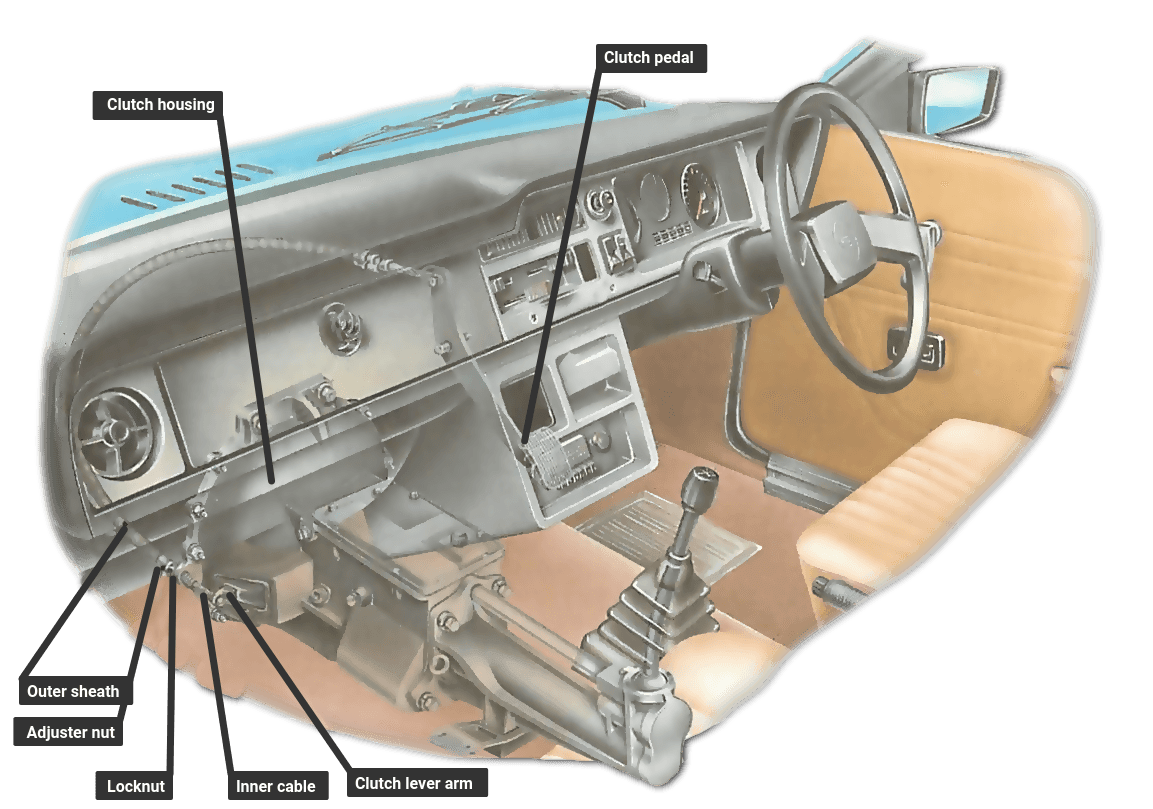
Conducting a visual inspection is an essential step in diagnosing a potential clutch cable issue. Start by locating the clutch cable, which is typically connected to the clutch pedal on one end and the clutch mechanism on the other. Examine the cable for signs of fraying, kinks, or visible wear. Pay close attention to areas where the cable bends or moves, as these are the points most susceptible to wear. Check the bulkhead (firewall) where the cable passes through, and the gearbox end where it connects to the clutch fork or lever — these are the two spots where cables most commonly fail.
Check for proper cable tension by pressing the clutch pedal. The cable should exhibit a slight amount of play before engaging the clutch mechanism. If the cable feels too loose or too tight, it’s an indication that the cable may need adjustment or replacement. On a manual-adjust cable you can usually take up slack with the adjuster nut; on a self-adjusting cable there is no user adjustment, so excess play points straight to replacement.
How to Confirm It’s the Cable (Not the Clutch or Hydraulics)
Before you buy a cable, rule out the two things that mimic a cable fault: a worn clutch and a hydraulic failure. If your car uses a hydraulic clutch (no cable at all), a soft or dead pedal points to a fluid leak or a failed master or slave cylinder, not a cable. If your car has a cable, do the free play test: with the engine off, press the pedal by hand and note how far it moves before you feel resistance. Excessive play suggests a stretched cable; no resistance at all suggests a snapped one. Then look at the bulkhead and gearbox ends for fraying, rust, or a cable that has pulled free of its mount. If the cable looks and feels fine but the clutch still slips under acceleration or shudders, the problem is more likely the clutch disc itself.
Seeking Professional Assessment
While visual inspections can provide valuable insights, diagnosing complex issues with the clutch cable often requires professional expertise. Mechanics possess the tools and knowledge to perform a thorough diagnosis, identifying not only clutch cable problems but also potentially related issues that might affect the overall clutch system. Consulting a professional mechanic is advisable when dealing with intricate systems like the clutch, as they can offer accurate assessments and appropriate solutions.
DIY Solutions and Maintenance
For minor clutch cable issues, there are a few steps you can take to improve cable performance. Lubricating the cable with a specialized cable lubricant can help reduce friction and enhance its lifespan. Additionally, minor adjustments to the cable tension can be made to ensure proper engagement and disengagement of the clutch — but only on cables with a manual adjuster. Self-adjusting cables cannot be tightened by hand. If the cable is frayed or snapped, lubrication and adjustment will not fix it and replacement is the only safe option.
Replacing a Bad Clutch Cable
If your visual inspection and professional assessment confirm that the clutch cable is indeed faulty, replacing it is the most effective solution. A replacement cable is generally inexpensive, and on many cars the job is a straightforward DIY task, though access at the bulkhead and gearbox can be tight. Here’s a step-by-step guide to replacing a bad clutch cable:
- Gather Tools and Replacement Parts: Ensure you have the necessary tools, including wrenches and pliers, along with a replacement clutch cable that matches your vehicle’s specifications.
- Disconnect the Old Cable: Begin by disconnecting the old clutch cable from both the clutch pedal and the clutch mechanism. This may involve removing fasteners and pins.
- Install the New Cable: Attach the new clutch cable at the pedal end first, then route it carefully along the original path, avoiding sharp bends that can cause premature wear.
- Connect and Adjust: Secure the cable at the gearbox end and set the free play according to your vehicle’s specification. On a manual-adjust cable, turn the adjuster nut until you have the correct amount of pedal play.
- Test: With the engine off, press the pedal several times to check for smooth operation, then start the car and confirm you can select all gears cleanly before driving.
Can You Drive With a Bad Clutch Cable?
If the cable has snapped, you cannot disengage the clutch, which means you cannot select gears normally and should not attempt to drive the car in traffic. On a stretched or frayed cable you may be able to limp carefully to a garage by matching revs and shifting without the clutch, but this is a short-distance, low-speed emergency measure only — it puts heavy wear on the gearbox and is unsafe in traffic. If you must move the car, do it in first or second gear at low speed and get it looked at immediately. A frayed cable can snap without warning, so treat any of these symptoms as urgent.

Preventive Measures for Clutch Cable Health
To prolong the life of your clutch cable and prevent premature wear, consider implementing these preventive measures:
1. Practice Smooth Shifting: Avoid aggressive or hasty gear changes that can put unnecessary stress on the clutch cable and mechanism.
2. Avoid Riding the Clutch: Resting your foot on the clutch pedal while driving causes constant tension on the cable and can lead to accelerated wear.
3. Regular Inspection and Lubrication: Include the clutch cable in your routine vehicle inspections. Lubricate the cable as recommended by your vehicle’s manual to reduce friction.
4. Gentle Pedal Operation: Operate the clutch pedal smoothly and avoid sudden, jerky movements that can strain the cable.
Repair Options, Costs, and DIY Difficulty
A replacement clutch cable is one of the cheaper clutch-related parts, and on many vehicles the job is within reach of a confident home mechanic with basic tools. The main difficulty is access: the pedal end is often up under the dashboard, and the gearbox end can be awkward on transverse-engined cars. If you are unsure about routing the cable correctly or setting the free play, a garage will do the job quickly. Costs vary widely by model and labour rates, so get a quote for your specific car rather than relying on a general figure. As a rough guide, a cable replacement is a fraction of the cost of a full clutch job — which is why confirming the cable is the fault before authorising any work matters.
Conclusion
The clutch cable is a linchpin in the manual transmission system, ensuring smooth gear changes and optimal driving experience. Recognizing the signs of a failing clutch cable and taking proactive measures can save you from the inconvenience of unexpected breakdowns and costly repairs. Whether through visual inspections, seeking professional expertise, or performing simple maintenance, your vigilance in caring for your clutch cable will contribute to the longevity and performance of your vehicle’s clutch system. Remember, a well-maintained clutch cable is the bridge between your driving intentions and the mechanical precision of your vehicle.
FAQ:
u003cstrongu003eHow do I know my clutch cable is broken?u003c/strongu003e
Signs include difficulty shifting gears, spongy pedal, pedal sticking, and clutch slippage. Visual inspection reveals wear or damage.
u003cstrongu003eWhat will happen if the clutch cable is broken?u003c/strongu003e
A broken clutch cable makes gear shifting challenging or impossible, leading to the inability to engage/disengage the clutch.
u003cstrongu003eHow do you check a clutch cable?u003c/strongu003e
Visually inspect the cable for fraying, kinks, or damage. Test clutch pedal resistance and smooth engagement while shifting gears.
u003cstrongu003eCan you drive with a broken clutch cable?u003c/strongu003e
Driving with a broken clutch cable is unsafe. Shifting gears becomes extremely difficult or impossible, risking further damage and safety issues.
Related posts:
 How To Put Down Nissan Altima Back Seats (All Model Years)
 What is Trailer Backup on Ford F150: Expert Guide for Safe Maneuvering
 How to Replace Rear Sliding Window Ford F150: The Ultimate Guide
 How Many O2 Sensors Does a Ford F150 Have
 What is 4A on F150: Unleashing the Power of 4A in Your Ford F150
 What Are Cam Phasers F150
How Much is a Windshield for a Ford F150: Find the Best Price Now!
 Best Aftermarket Radio For 2013 Ford F150: Expert Picks
 Best Floor Jack for F150
 How to Get a Spare Tire off a Ford F150
 5 Best Ford F150 Bed Covers: Expert Picks & Quality Tested
 Best Tuners for Ford F150 EcoBoost to Boost Performance