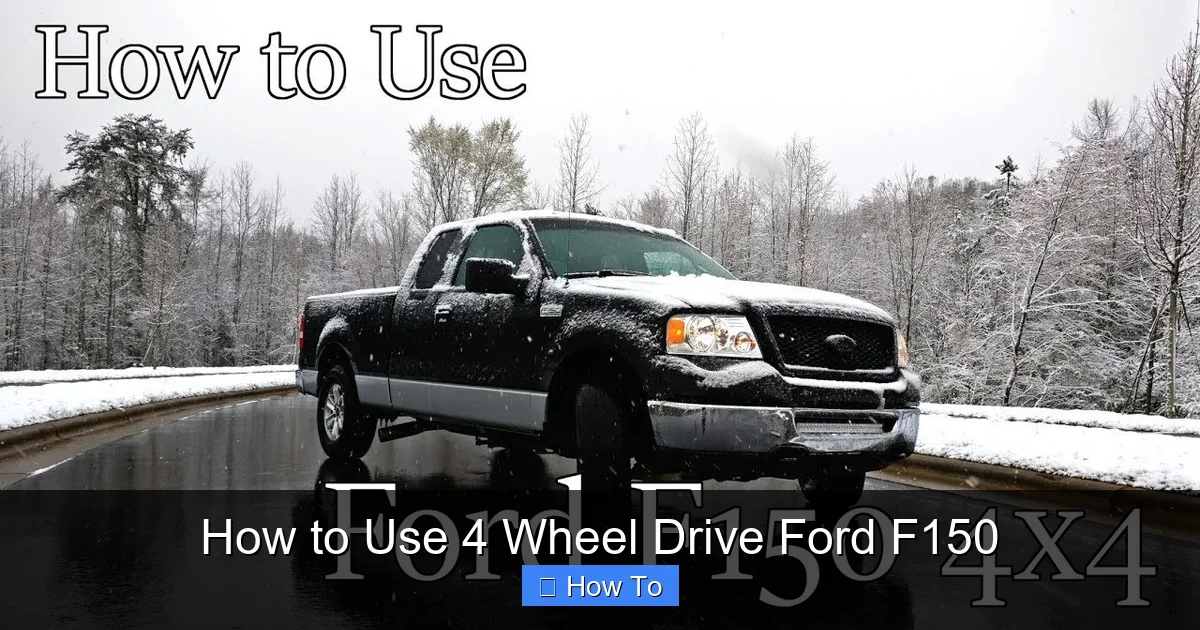
How to Use 4 Wheel Drive Ford F150
This guide teaches how to use 4 wheel drive Ford F150 safely and effectively. You’ll learn when and how to shift between drive modes, handle different terrains, and maintain your system for peak performance.
Key Takeaways
- Know your drive modes: The Ford F150 offers 2H, 4H, 4L, and sometimes 4A—each designed for specific driving conditions.
- Shift on the fly (in most models): You can switch between 2H and 4H while driving up to 55 mph, but always come to a stop before engaging 4L.
- Use 4H for slippery or loose surfaces: Ideal for snow, mud, gravel, or wet roads—don’t use it on dry pavement to avoid drivetrain damage.
- Engage 4L only at low speeds: Use this low-range mode for steep climbs, deep mud, or rock crawling—never above 5–10 mph.
- Regular maintenance is key: Check transfer case fluid, inspect driveshafts, and test 4WD monthly to ensure reliability.
- Avoid dry pavement in 4WD: Using 4H or 4L on dry roads causes binding and can damage your truck’s drivetrain.
- Practice in a safe area: Before hitting tough trails, test your 4WD system in an empty parking lot or field.
How to Use 4 Wheel Drive Ford F150: A Complete Guide
If you own a Ford F150 with four-wheel drive (4WD), you’ve got a powerful tool for tackling tough terrain—whether it’s snow-covered backroads, muddy trails, or rocky off-road paths. But using 4WD isn’t just about flipping a switch. To get the most out of your truck and avoid costly damage, you need to understand how to use 4 wheel drive Ford F150 correctly.
This guide walks you through everything: from identifying your truck’s 4WD system to shifting between modes, driving safely in different conditions, and maintaining your system. Whether you’re a weekend warrior or a daily driver facing winter storms, this step-by-step guide will help you master your F150’s 4WD capabilities.
Understanding Your Ford F150’s 4WD System

Visual guide about how to use 4 wheel drive ford f150
Image source: revfrenzy.com
Before you engage 4WD, it’s important to know what kind of system your F150 has. Most modern Ford F150s come with one of two types:
- Part-time 4WD: This is the most common setup. It allows you to switch between two-wheel drive (2H) and four-wheel drive (4H or 4L). It’s ideal for off-road use and slippery conditions but should never be used on dry pavement.
- Automatic 4WD (4A): Found on some newer models, this mode automatically sends power to all four wheels when traction is lost. It’s great for variable conditions like rain or light snow and can be used on dry roads.
Your truck’s 4WD system is controlled either by a physical lever (older models) or an electronic switch or dial on the dashboard (2015 and newer). Check your owner’s manual to confirm which system you have.
Step-by-Step: How to Engage 4 Wheel Drive on a Ford F150

Visual guide about how to use 4 wheel drive ford f150
Image source: automasterx.com
Now that you know your system, let’s go over how to shift into 4WD safely and correctly.
Step 1: Identify Your Control Method
Most F150s from 2015 onward use an electronic 4WD dial located on the center console, usually near the climate controls. Older models (pre-2015) may have a floor-mounted lever between the front seats.
- Electronic dial: Turn the dial to select 2H, 4H, 4L, or 4A (if equipped).
- Manual lever: Push or pull the lever to shift between modes. Some require you to press a button while shifting.
Step 2: Know When to Use Each Mode
Each 4WD mode serves a specific purpose. Using the wrong one can damage your truck or reduce performance.
- 2H (Two-High): Default mode for normal driving on dry pavement. Power goes to the rear wheels only. Use this for highway driving and everyday commuting.
- 4H (Four-High): Engages all four wheels at high speeds. Use this for snow, mud, gravel, or wet roads. You can shift into 4H while driving up to 55 mph—no need to stop.
- 4L (Four-Low): Provides maximum torque at very low speeds. Use only for extreme conditions like rock crawling, steep inclines, or deep mud. You must come to a complete stop before engaging 4L.
- 4A (Four-Auto): Automatically adjusts power between two and four wheels based on traction. Great for unpredictable conditions. Can be used on dry roads.
Step 3: Shifting into 4H (Four-High)
This is the most common 4WD mode for everyday adverse conditions.
- Drive at a speed under 55 mph.
- Slow down slightly if the road is rough or slippery.
- Turn the dial to “4H” (or move the lever to 4H).
- You may hear a slight clunk—this is normal as the front axle engages.
- Continue driving. The system will now send power to all four wheels.
Tip: If you’re driving on snow or ice, engage 4H before you start slipping. It’s easier to maintain traction than to regain it.
Step 4: Shifting into 4L (Four-Low)
Use 4L only when you need maximum pulling power at very low speeds.
- Come to a complete stop. Do not attempt to shift into 4L while moving.
- Press the brake firmly.
- Shift the transmission into Neutral (N).
- Turn the dial to “4L” (or move the lever to 4L).
- Shift the transmission back into Drive (D).
- Release the brake and proceed slowly.
Warning: Never exceed 10 mph in 4L. This mode is for crawling, not cruising.
Step 5: Returning to 2H
When road conditions improve, switch back to 2H to avoid drivetrain stress.
- If you’re in 4H, you can shift back to 2H at any speed under 55 mph.
- If you’re in 4L, come to a stop, shift to Neutral, select 2H, then return to Drive.
Driving Tips for Different Terrains

Visual guide about how to use 4 wheel drive ford f150
Image source: f150insight.com
Using 4WD isn’t just about flipping a switch—it’s about driving smart. Here’s how to handle common conditions.
Snow and Ice
- Engage 4H before roads get too slippery.
- Accelerate and brake gently to avoid skidding.
- Use lower gears when descending hills.
- Avoid sudden steering movements.
Example: If you’re driving up a snowy driveway, shift to 4H before you start climbing. This prevents wheel spin and helps you maintain control.
Mud and Deep Snow
- Use 4H for moderate mud or snow.
- Switch to 4L if you’re stuck or climbing a steep, muddy slope.
- Maintain steady momentum—don’t stop once you’re moving.
- If you get stuck, rock the truck gently by shifting between Drive and Reverse.
Gravel and Dirt Roads
- 4H is ideal for loose surfaces.
- It improves stability and reduces the chance of sliding.
- Avoid sharp turns at high speed—4WD doesn’t improve cornering grip.
Rock Crawling and Off-Roading
- Use 4L for maximum control and torque.
- Go slow—speed is your enemy on technical trails.
- Use low-range gearing to crawl over obstacles.
- Consider adding off-road tires and skid plates for extra protection.
Common Mistakes to Avoid
Even experienced drivers make errors with 4WD. Here’s what to watch out for.
Using 4H or 4L on Dry Pavement
This is the #1 mistake. Part-time 4WD systems are not designed for dry roads. The lack of a center differential means the front and rear axles can’t rotate at different speeds during turns, causing “binding” or “wind-up.” This can damage your transfer case, driveshafts, or axles.
Solution: Only use 4H or 4L on slippery or loose surfaces. Return to 2H as soon as conditions improve.
Shifting into 4L While Moving
Never shift into 4L without stopping first. Doing so can cause severe mechanical shock.
Solution: Always come to a complete stop, shift to Neutral, then select 4L.
Forgetting to Disengage 4WD
Leaving your truck in 4H or 4L on the highway wastes fuel and stresses the drivetrain.
Solution: Make it a habit to check your 4WD mode when road conditions change.
Troubleshooting 4WD Issues
If your 4WD isn’t working properly, here are some common fixes.
4WD Won’t Engage
- Check the fuse for the 4WD system (usually in the cabin fuse box).
- Ensure the transfer case fluid is at the correct level.
- Try shifting into 4H while driving slowly (under 10 mph).
- If using a manual lever, make sure it’s fully seated.
Grinding or Clunking Noise
- This may indicate low transfer case fluid or worn U-joints.
- Have a mechanic inspect the driveshaft and front axle.
- Never ignore unusual noises—they can signal serious damage.
4WD Light Flashing or Not Illuminating
- Check the 4WD control module or sensors.
- Reset the system by turning the truck off, waiting 10 seconds, then restarting.
- If the problem persists, visit a Ford dealer for diagnostics.
Maintaining Your 4WD System
Regular maintenance keeps your 4WD running smoothly.
- Check transfer case fluid: Every 30,000 miles or as recommended in your owner’s manual.
- Inspect driveshafts and U-joints: Look for cracks, rust, or play.
- Lubricate front axle hubs: Some models require manual locking hubs to be greased.
- Test 4WD monthly: Even if you don’t use it often, shift into 4H and 4L briefly to keep components moving.
Pro Tip: If you live in a snowy area, flush and replace transfer case fluid every 60,000 miles to prevent moisture buildup.
Conclusion
Mastering how to use 4 wheel drive Ford F150 gives you confidence and control in challenging conditions. Whether you’re plowing through snow, navigating muddy trails, or just want better traction on wet roads, your F150’s 4WD system is a powerful asset—when used correctly.
Remember: know your modes, shift at the right time, avoid dry pavement in 4H/4L, and maintain your system regularly. With these tips, you’ll get the most out of your truck while protecting its drivetrain for years to come.
So next time the weather turns nasty or the trail gets tough, you’ll be ready. Just dial in the right mode, drive smart, and enjoy the ride.
Related posts:
 How Do Ball Joints Work: A Comprehensive Guide
 How Do I Know If My Clutch Cable Has Gone
 Can Spark Plugs Really Break Glass
 How Big of Tires Can I Fit on My F150? A Comprehensive Guide
 How Can I Protect My Windshield From Rock
 How Do Spark Plugs Break Windows
 How Far Can I Drive With A Bad Alternator
 How Far Can I Drive With A Blown Water Pump
 How Far Can I Drive With A Broken Serpentine Belt
 How Far Can You Drive With A Dead Battery
 How Far Can You Drive Without An Alternator
 How To Put Down Nissan Altima Back Seats