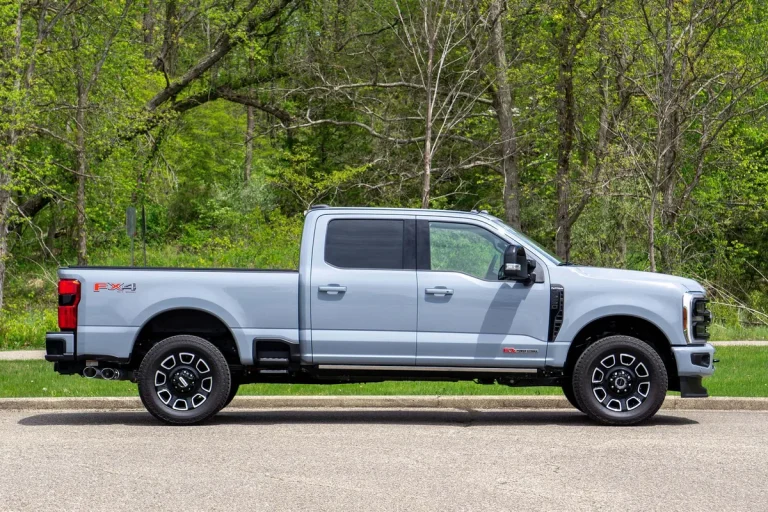
Can a Ford F250 Tow a Fifth Wheel
Can a Ford F-250 tow a fifth wheel? The short answer is yes, but only if your specific truck, trailer, and hitch setup align safely. Many owners assume the published tow rating tells the whole story, but real-world towing hinges on a less obvious number: payload capacity. If you ignore it, you risk overloading your truck even when staying under the max tow limit.
Manufacturer specifications indicate the F-250 Super Duty can handle up to 21,000 pounds when properly equipped as of 2026, per SAE J2807 testing standards. But that figure assumes ideal conditions, full tank, no passengers, and minimal cargo. In practice, your actual safe towing capacity depends on how much weight your truck can carry, not just pull.
The Real Answer Isn’t Just About Tow Rating
Tow ratings get all the attention, but they’re only half the equation. The Ford F-250’s maximum tow capacity ranges from about 18,000 to 21,000 pounds depending on cab configuration, bed length, axle ratio, and drivetrain. However, that number doesn’t account for what’s already in or on your truck, passengers, gear, fuel, and especially the hitch weight from your fifth wheel.
Fifth-wheel trailers transfer significant weight directly onto the truck’s bed via the kingpin. This hitch weight typically runs 15% to 25% of the trailer’s total gross weight. For a 14,000-pound trailer, that’s 2,100 to 3,500 pounds pressing down on your rear axle, before you’ve even added a cooler or tools. If your F-250’s payload capacity is only 3,800 pounds (common for Crew Cab 4×4 models), you’ve already used most of it just on the hitch.
Why Payload Matters More Than You Think
Payload is the total weight your truck can carry, including passengers, cargo, fuel, and hitch weight. It’s listed on the driver’s door jamb sticker and varies widely, from roughly 3,200 to over 4,200 pounds across F-250 configurations. Unlike tow rating, which is theoretical, payload is a hard ceiling. Exceed it, and you’re compromising braking, handling, and suspension integrity.
Many owners mistakenly believe that staying under the tow rating keeps them legal and safe. But if your hitch weight plus everything else in the truck pushes you past GVWR (Gross Vehicle Weight Rating), you’ve created a dangerous imbalance. The rear tires may lose traction, steering becomes sluggish, and stopping distances increase dramatically, especially downhill or in wet conditions.
F-250 Towing Capacity: What the Numbers Really Mean
Ford publishes detailed towing guides broken down by model year, engine, cab style, bed length, axle ratio, and drivetrain. For example, a 2026 F-250 SuperCab 4×2 with the 7.3L gas V8, 3.55 axle ratio, and 8-foot bed might list a max tow of 18,500 pounds. Swap to the 6.7L Power Stroke diesel with 3.73 gears and 4×4, and that jumps to 21,000 pounds.
But these numbers assume you’re starting with an empty truck, no passengers, no gear, full fuel. Realistically, subtract at least 600, 800 pounds for a driver, passenger, and basic essentials. Then add your hitch weight. If your trailer’s GVWR is 16,000 pounds and it’s loaded to 14,000, expect 2,800 pounds of hitch weight.
That leaves very little room for anything else if your payload cap is 3,900 pounds.
| Configuration | Max Tow Rating (lbs) | Typical Payload (lbs) |
|---|---|---|
| Crew Cab 4×4 Gas | 18,500 | 3,600 |
| Crew Cab 4×4 Diesel | 21,000 | 3,900 |
| Regular Cab 4×2 Diesel | 21,000 | 4,200 |
Always cross-check your door jamb sticker, it shows your truck’s actual payload, not the best-case scenario.
Fifth-Wheel Hitch Weight: The Hidden Payload Killer
Fifth-wheel hitches aren’t free. A typical hitch system weighs 150, 300 pounds, and that counts against your payload the moment it’s installed. Then comes the trailer’s pin weight, the downward force on the hitch. Even lightweight fifth wheels often have 2,000+ pounds of pin weight when loaded.
This is where many F-250 owners run into trouble. They buy a trailer based on tow rating alone, only to discover their truck can’t legally carry the hitch weight without exceeding GVWR. The result? Either they remove essential gear, upgrade to an F-350, or, worse, tow anyway and risk instability or failure.
To avoid this, always check your trailer’s pin weight spec (listed on the manufacturer’s sticker) and compare it to your truck’s remaining payload after accounting for people, fuel, and accessories. If the numbers don’t add up, you need a lighter trailer or a heavier-duty truck.
Short-Bed vs. Long-Bed: Clearance and Control Trade-Offs
Short-bed F-250s (6.75-foot beds) save weight and improve maneuverability in tight spaces, but they create clearance issues with many fifth wheels. When you turn sharply, the trailer’s front overhang can contact the cab, especially on trailers with extended nose designs. Long-bed models (8-foot) offer more clearance, reducing the risk of damage and allowing tighter turns without scraping.
If you’re set on a short-bed F-250, look for trailers with a recessed pin box or consider a sliding fifth-wheel hitch. These hitches move the pivot point rearward during turns, effectively adding inches of clearance. However, they add complexity and cost, and some reduce payload capacity due to their weight.
Gas vs. Diesel: Which F-250 Engine Handles Fifth Wheels Best?
The 7.3L V8 gas engine delivers strong low-end torque and lower upfront cost, making it a solid choice for occasional towing under 15,000 pounds. It’s simpler mechanically and cheaper to maintain, with readily available parts and no diesel exhaust fluid (DEF) system to manage.
The 6.7L Power Stroke diesel, however, dominates for heavy fifth-wheel use. Its massive torque, over 1,000 lb-ft in recent models, provides effortless hill climbing and controlled downhill braking. Diesel engines also tend to last longer under sustained load, though they cost more upfront and require DEF and more frequent oil changes. For trailers over 16,000 pounds or frequent mountain driving, the diesel’s durability and control justify the premium.
Step-by-Step: How to Calculate If Your F-250 Can Tow Your Trailer
Start with your truck’s door jamb sticker: note the GVWR and payload capacity. Subtract the weight of all passengers, cargo, fuel (assume full tank), and any accessories like toolboxes or bed liners. What’s left is your available payload for hitch weight.
Next, find your trailer’s pin weight, usually listed on a sticker near the kingpin or in the owner’s manual. Add the weight of your fifth-wheel hitch (check the manufacturer’s specs). If the total exceeds your remaining payload, you’re overloaded before moving.
Finally, confirm the combined weight of truck and trailer doesn’t surpass the GCWR (Gross Combined Weight Rating), also on the door jamb. If all three numbers, payload, GVWR, and GCWR, check out, your setup is legal and safe.
Common Mistakes That Turn a Legal Tow Into a Dangerous One
Ignoring the hitch weight is the biggest error. Many owners focus only on trailer length and total weight, forgetting that 20%+ of that load sits directly on their truck’s rear axle. This shifts the center of gravity rearward, reducing front tire grip and making steering less responsive.
Another pitfall is assuming all fifth-wheel hitches are compatible. Short-bed trucks need specific hitches with clearance features, and not all frames support aftermarket installations without reinforcement. Always verify hitch compatibility with your exact F-250 model year and bed configuration.
Overloading the trailer itself compounds the problem. Even if your truck can handle the pin weight, an unbalanced or overweight trailer causes sway, tire blowouts, and brake failure. Keep trailer cargo low and centered, and never exceed the trailer’s GVWR, even if your truck could theoretically pull more.
When to Upgrade to an F-350 (or Downgrade Your Trailer)
If your calculations show you’re within 500 pounds of your payload or GVWR, step up to an F-350. The heavier-duty chassis, stronger rear axle, and higher payload capacity (often 4,500+ pounds) provide a safer margin. The cost difference is modest compared to the risk of overloading.
Conversely, if your heart’s set on the F-250, choose a lighter fifth wheel. Look for models under 12,000 pounds GVWR with compact front ends to minimize pin weight. Many modern lightweight fifth wheels use aluminum frames and composite walls to shed hundreds of pounds without sacrificing livability.
The key is honesty about your real-world usage. Occasional weekend trips? An F-250 might suffice. Full-time RVing with full tanks and gear?
The F-350’s extra capacity isn’t optional, it’s essential.
Safety Checks You Can’t Skip Before Hitting the Road
Always inspect your fifth-wheel hitch before each trip. Check that all bolts are torqued to spec, the locking mechanism engages fully, and there’s no visible wear on the kingpin or saddle. A loose or worn hitch can disengage unexpectedly, even at low speeds.
Verify your brake controller is calibrated and functioning. Test it in a safe area by applying trailer brakes independently, they should respond smoothly without jerking. If your trailer has electric-over-hydraulic brakes, listen for the pump engaging when you press the brake pedal.
Check tire pressures on both truck and trailer, including spares. Underinflated trailer tires generate excess heat and are a leading cause of blowouts. Use a quality pressure gauge and adjust for ambient temperature, cold mornings mean lower readings.
Expert Tips for Smooth, Stable Fifth-Wheel Towing
Load your trailer with 60% of the weight forward of the axles and keep heavy items low. This minimizes sway and ensures proper pin weight. Avoid stacking gear high in the front cap, it raises the center of gravity and increases wind resistance.
Use a weight distribution hitch only if your trailer manufacturer recommends it. Most fifth wheels don’t need one, but if your truck sags noticeably or handles poorly, a properly rated slider hitch can help balance the load.
Maintain steady throttle on hills. Diesel F-250s excel here, use engine braking by downshifting early rather than riding the brakes. For gas engines, avoid sudden acceleration; let the torque build gradually to prevent driveline shock.
Final Verdict: Is Your F-250 Setup Right for the Job?
Your F-250 can tow a fifth wheel safely if three conditions align: your payload capacity exceeds hitch weight plus occupants and gear, your GVWR isn’t exceeded, and your GCWR covers the combined rig. If any of these fall short, don’t compromise, either lighten your load, choose a smaller trailer, or upgrade to an F-350.
Don’t rely on dealer estimates or online calculators alone. Print your truck’s door jamb sticker, your trailer’s weight certification label, and Ford’s official towing guide. Do the math yourself. When in doubt, err on the side of caution, overloading feels fine until it doesn’t.
Related posts:
 How Much Can Ford F250 Tow
Does a 2015 Ford F250 Have a Cabin Air Filter
How Many Cab Mount Bushings Ford F250
How Much Can a Ford F250 6.2 Gas Engine Tow
How Much Does a Ford F250 Crew Cab Weight
How Tall Is Ford F250
How to Draw a Ford F250
How to Lock the Hubs on Ford F250 (Real-World Picks)
How to Replace Ford F250 Door Handle in 2026 (Expert Picks)
How to Reset Ambient Temperature Sensor Ford F250 in 2026
How to Sync Phone to Ford F250 — That Actually Work
 Best Shocks for Ford F250